Always shipping

Changelog

Every update to Divebase, in order. The thinking, the screenshots, and the why behind each one.

RSS feed

Equipment service tracking for dive gear

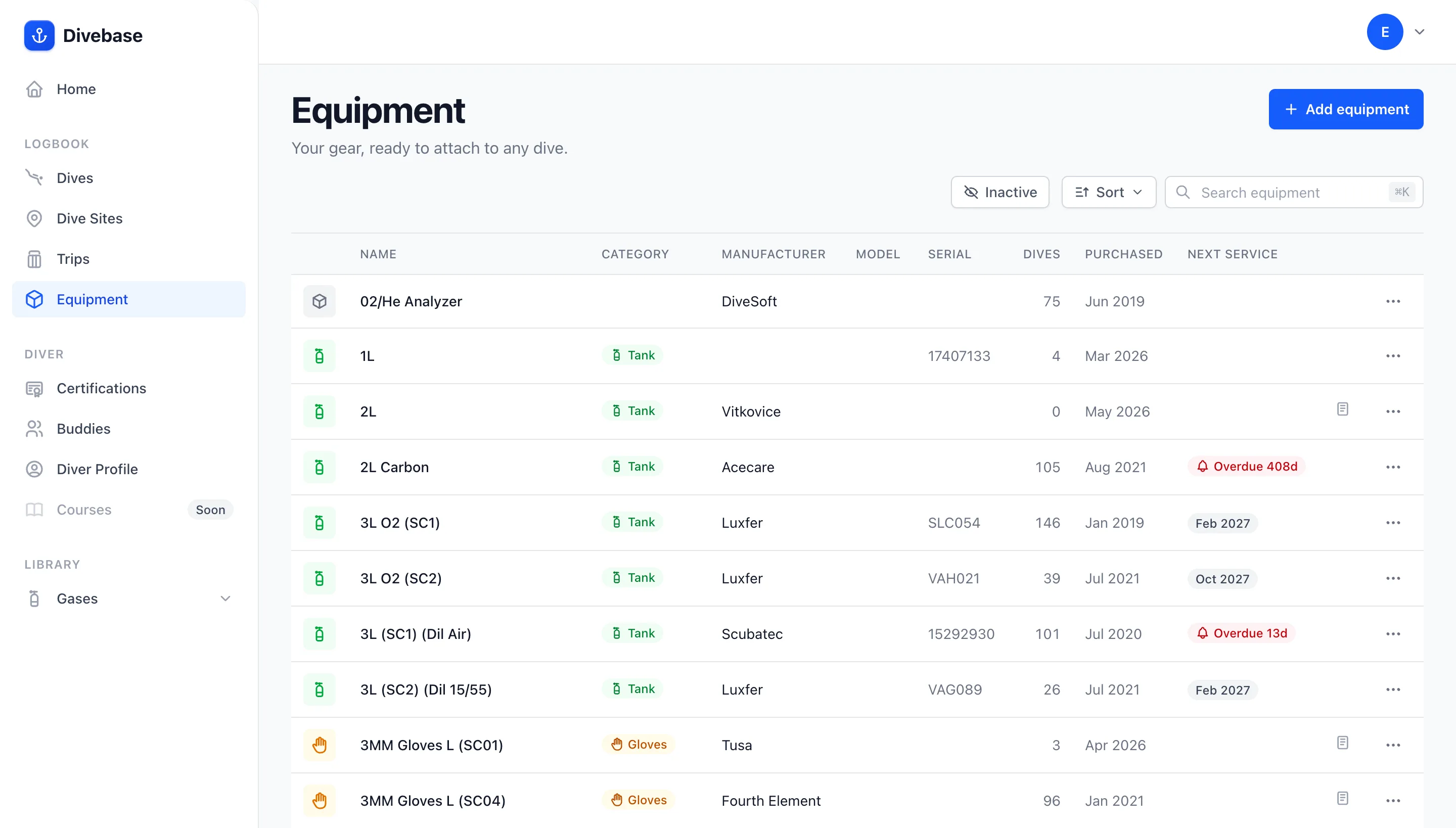
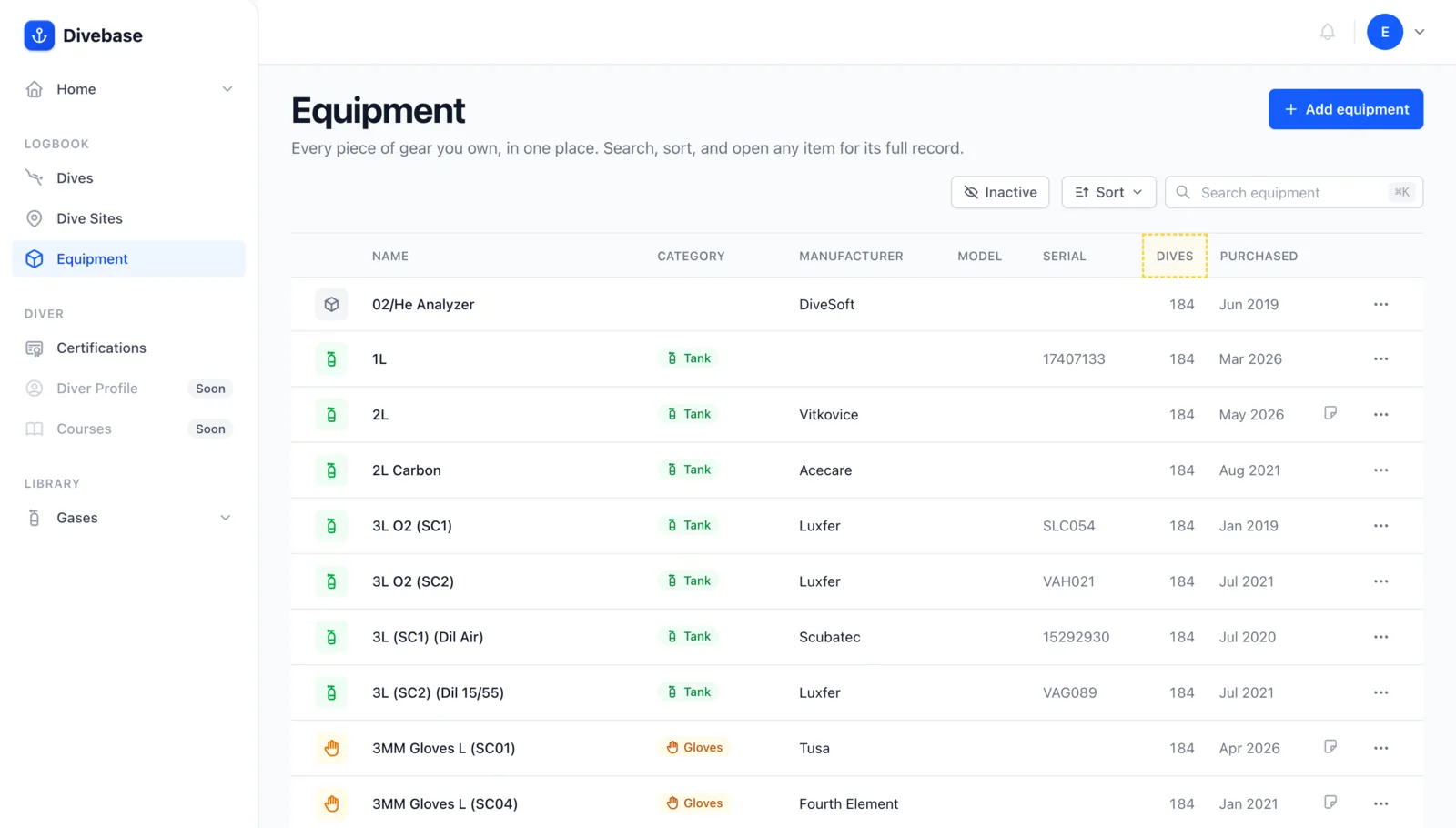
The Divebase equipment list with a Next Service column, some items showing an upcoming month and others flagged in red as overdue by a number of days

Gear that keeps you alive deserves a maintenance record. Regulators get overhauled, tanks get their hydro test, rebreather sensors get swapped: every piece of kit has its own rhythm of servicing, and forgetting where each one stands is how you end up on the boat with a cylinder that's out of test. When I opened the Equipment section I promised the Service tab was coming. Today it's here.

Service tracking gives every item in your inventory a full maintenance history and a clear next-service date, so you always know what's been done and what's due. It's more than good housekeeping: as of May 2026, Italy's "Legge del Mare" makes keeping a register of equipment testing and maintenance a legal requirement for diving operators (Legge 7 maggio 2026, n. 70). Whether you're a professional who has to keep the register or a diver who just wants peace of mind, it's the same tab.

Read update

Introducing Trips

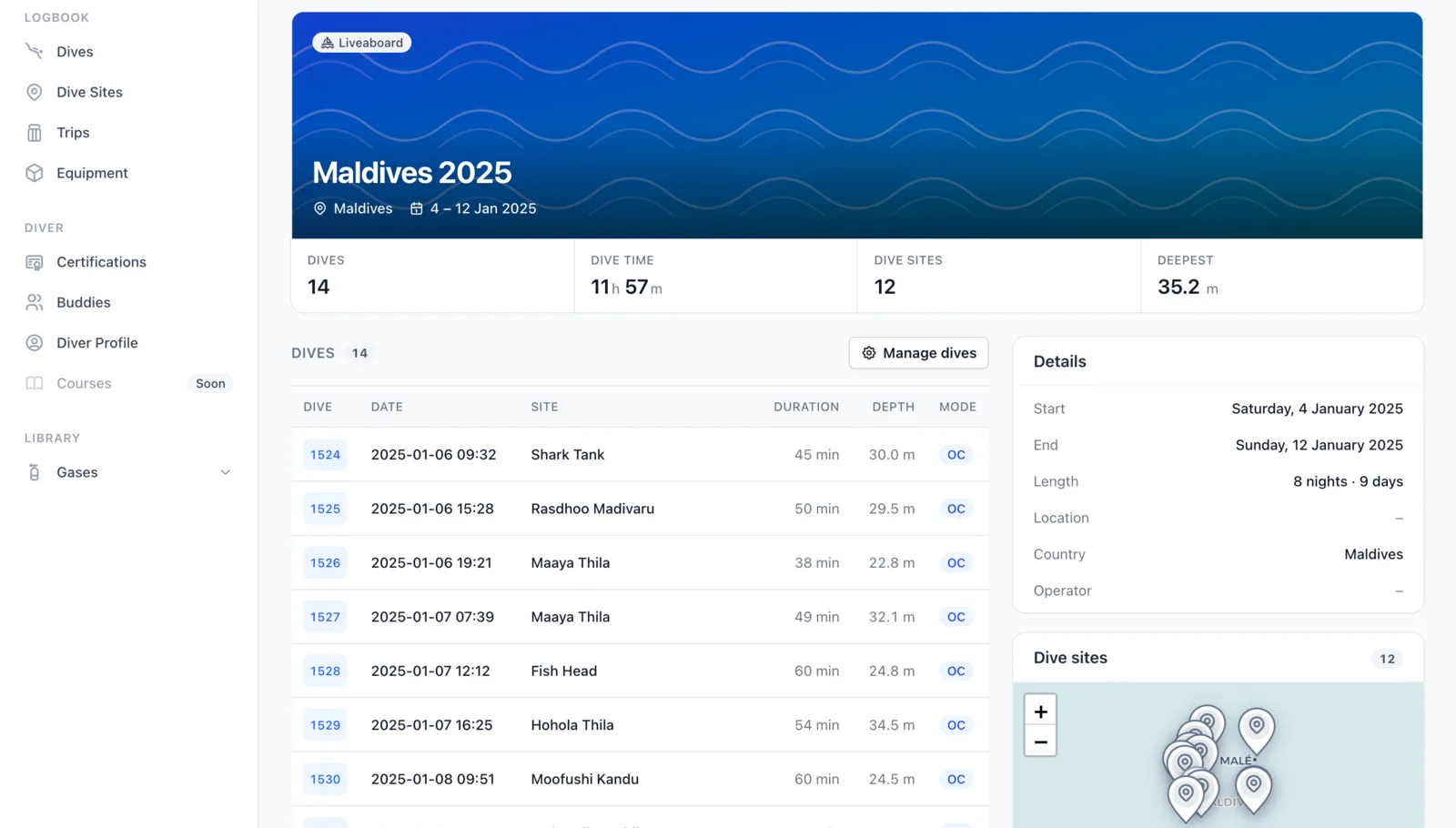
A Divebase trip page for a Maldives liveaboard, showing the dive count, total dive time, sites and deepest dive up top, the full list of dives, and a map of every site visited

Some dives belong together. The fourteen you logged on that liveaboard week in the Maldives, the handful from a weekend at the local quarry, the season of dives from a research campaign: they're not just entries scattered down your logbook, they're a journey. Today Divebase gets a whole new section to hold them. Meet Trips.

A trip groups the dives you logged on a single journey into one place, with its own dates, its own location, and its own running totals. Instead of scrolling your logbook and squinting at dates to remember which dives came from where, you open a trip and the whole journey is right there: every dive, every site, the total bottom time, the deepest point, all of it summed up for you.

This is a feature I've wanted for a very long time. I've kept my logbook in MacDive for over ten years, and it's still my favourite divelog, but it has no concept of a trip, and neither do many other divelogs. Every time I came home from a week of diving I wished I could wrap those dives into something I could name, revisit, and look back on as one. So I built it.

There are all sorts of ways to use a trip. A few that I reach for:

  • Liveaboard — a week aboard a boat, hopping between sites. The trip becomes the story of the whole cruise.
  • Resort — a diving holiday based out of a resort or a single dive center.
  • Excursion — a short outing, a weekend or a day trip to a nearby site.
  • Expedition — a longer, more serious campaign, often with a purpose beyond leisure.
  • Other — anything that doesn't fit the moulds above; the box is yours to fill.

I want to say a word about expeditions, because they're close to my heart. An expedition is more than a holiday: it's a campaign with a goal, and very often that goal is research. Marine biologists, archaeologists surveying a wreck, teams mapping a cave system, citizen-science groups running transects season after season: all of them dive with intent, and all of them need to keep the dives from a single campaign together, distinct from their recreational logbook. Grouping a research campaign as an expedition, with its dates, its location, and its operator, gives that work a home. If you dive for science, Divebase now speaks your language too.

Read update

Recording your dive conditions

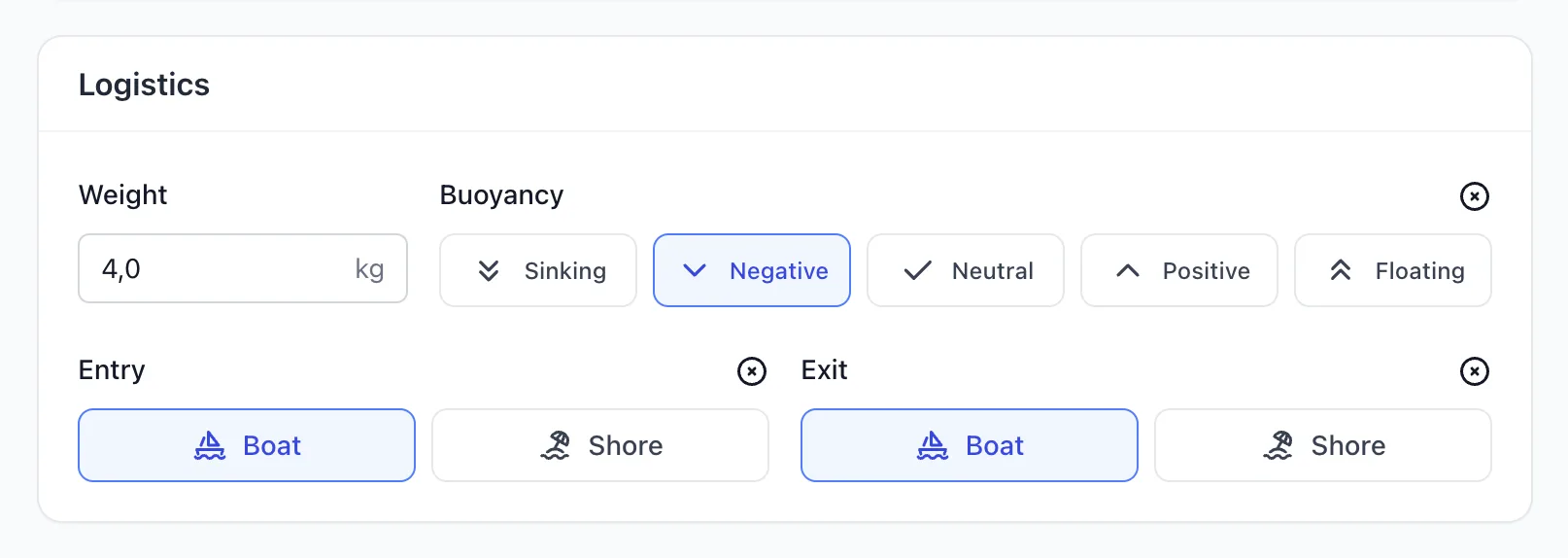
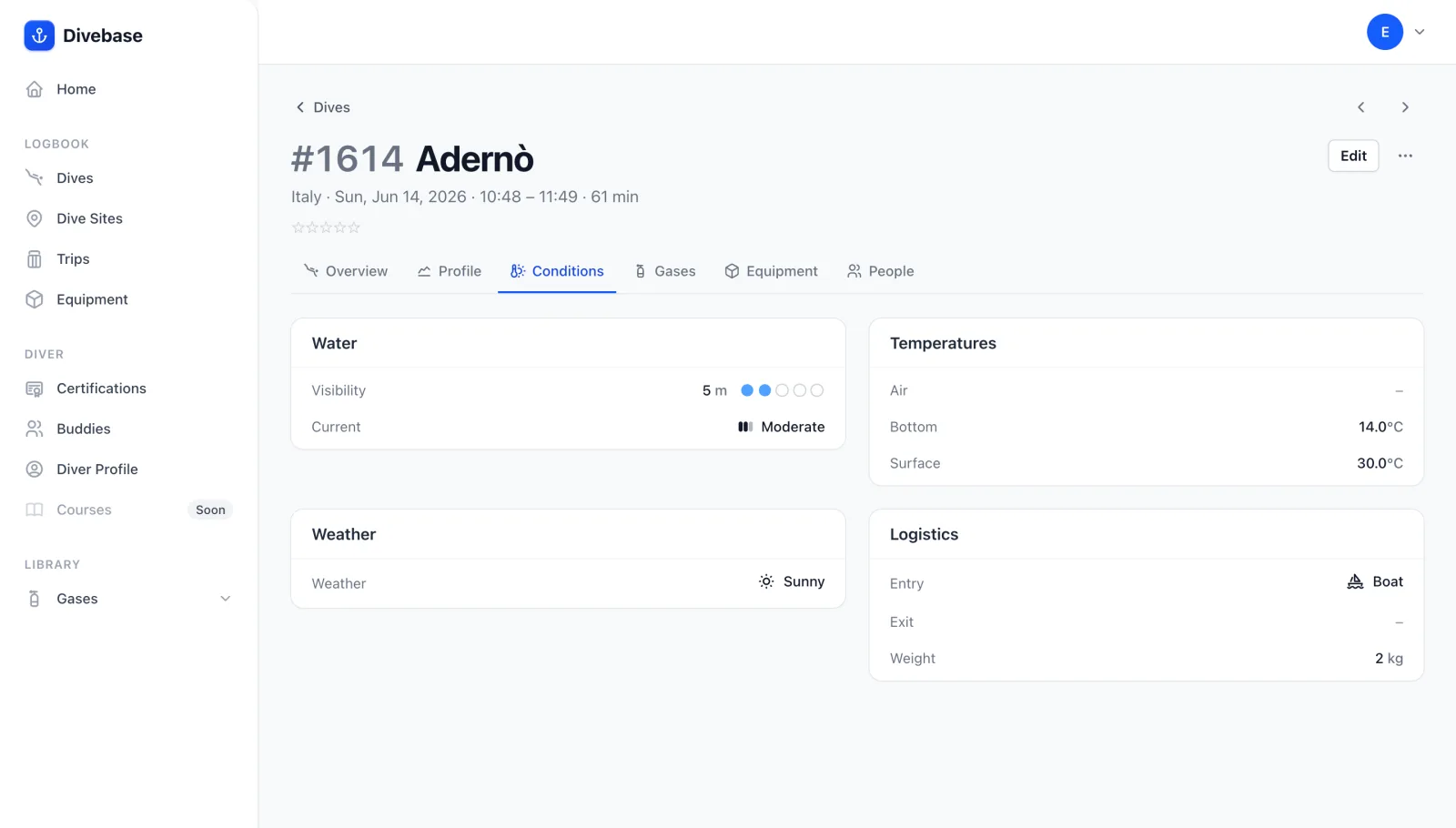
The new Conditions tab on a Divebase dive, showing the Water, Temperatures, Weather, and Logistics panels

A dive is shaped by the water it happens in. The same site is a different dive on a calm, clear morning than it is in a cold, murky current. Today Divebase gains a small but genuinely useful addition: a new Conditions tab on every dive, where you can record and revisit the conditions you dived in. These are the details that never fit in the basics but tell the real story of a dive, and having them on hand changes how much a logged dive is worth to you later.

So what can you record as dive conditions? The Conditions tab gathers everything into four panels:

  • Water — how far you could see and how the water was moving. Visibility is a distance in meters, paired with a clarity rating from Zero to Excellent for the times a number alone doesn't capture the impression. Current runs from none through light, moderate, and strong.
  • Temperatures — the air temperature above the surface, and the water temperature at its warmest (near the surface) and its coldest (down at depth), so a dive through a sharp thermocline reads at a glance.
  • Weather — the sky over the surface: sunny, cloudy, rainy, windy, or foggy.
  • Logistics — the practical side of the dive: whether you got in and out by boat or from shore, and how much weight you carried.
Read update

Introducing the interactive dive chart

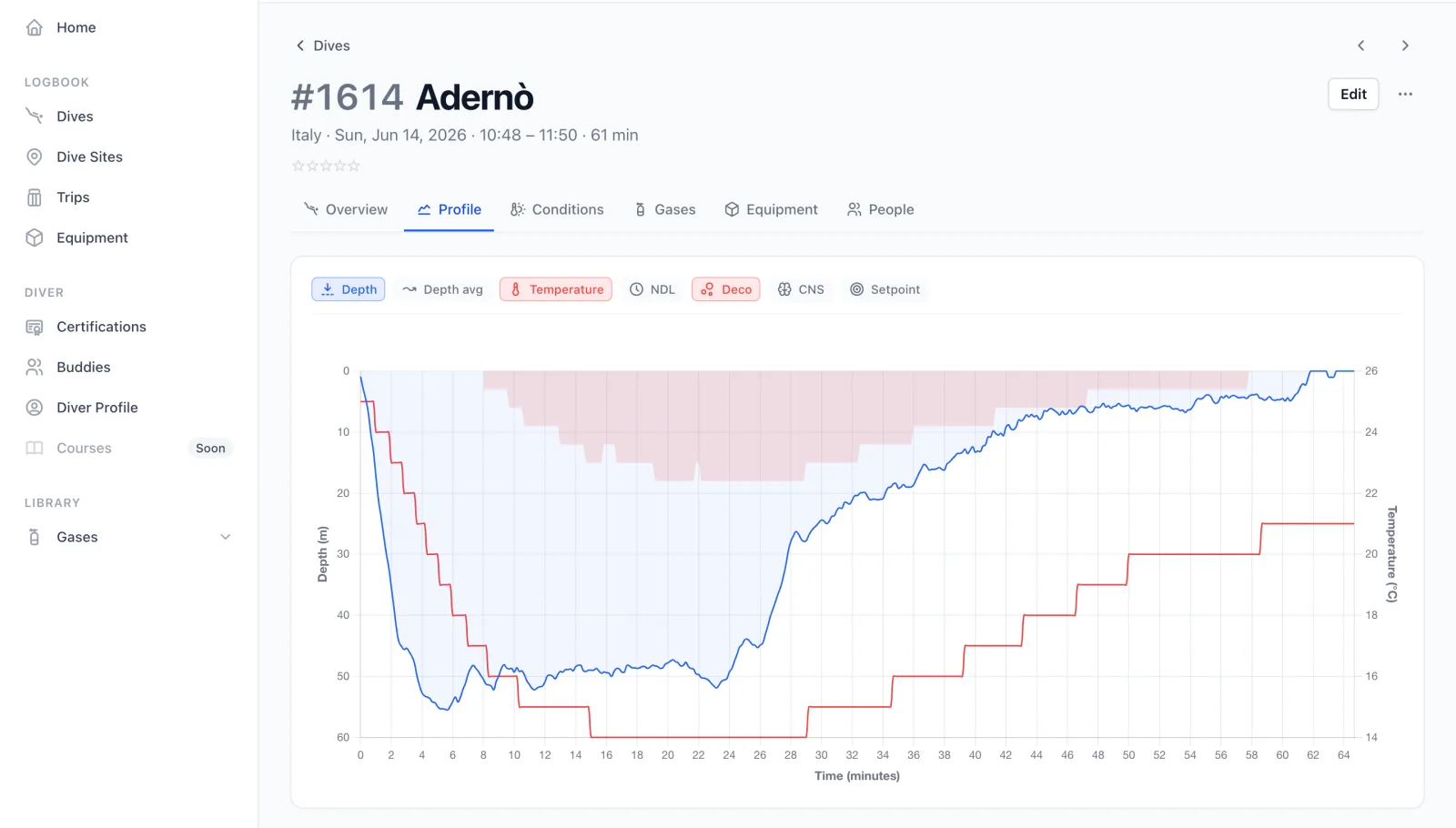
The Divebase interactive dive chart tracing depth against time, with the channel toggles ranged across the top

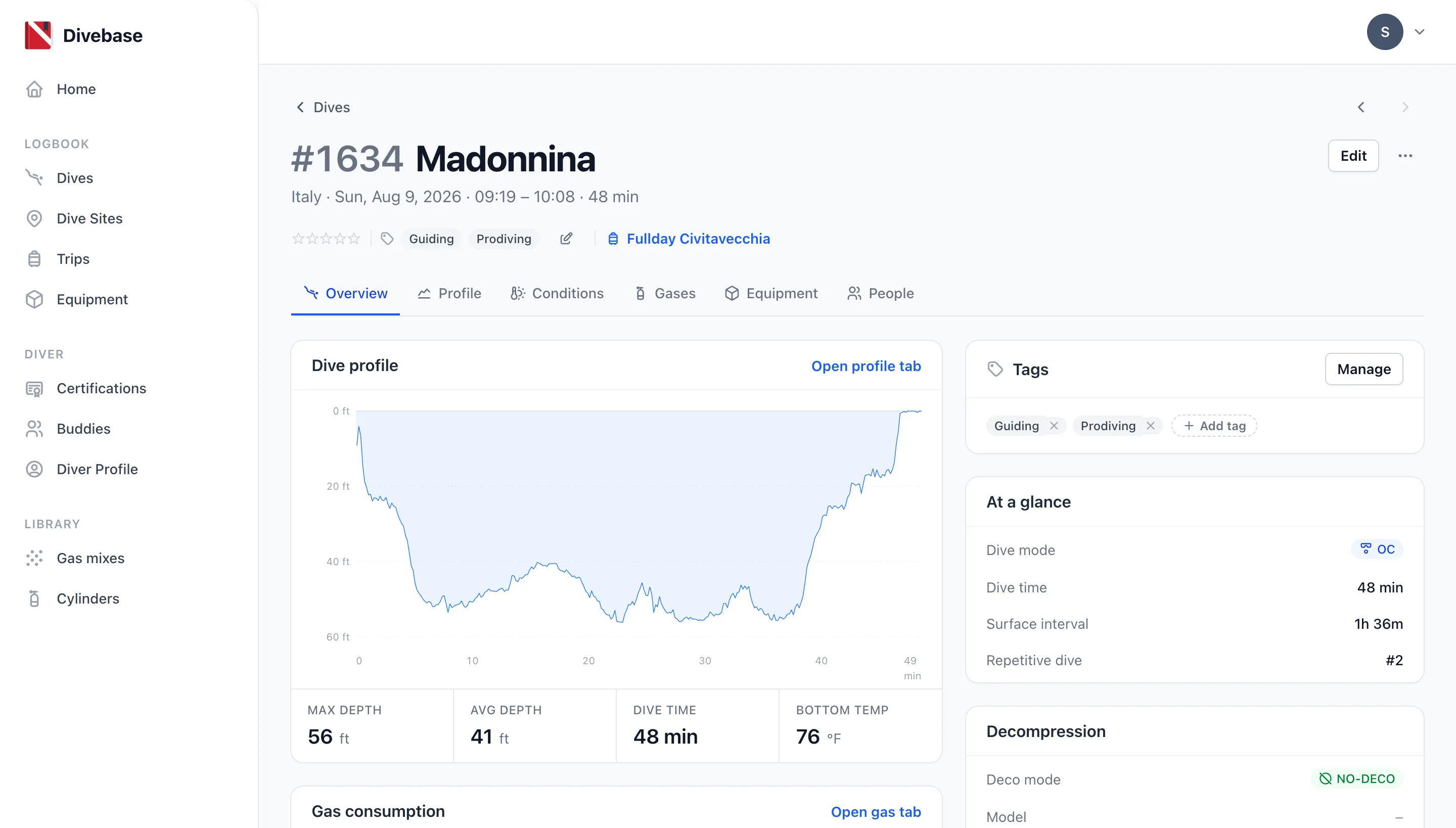
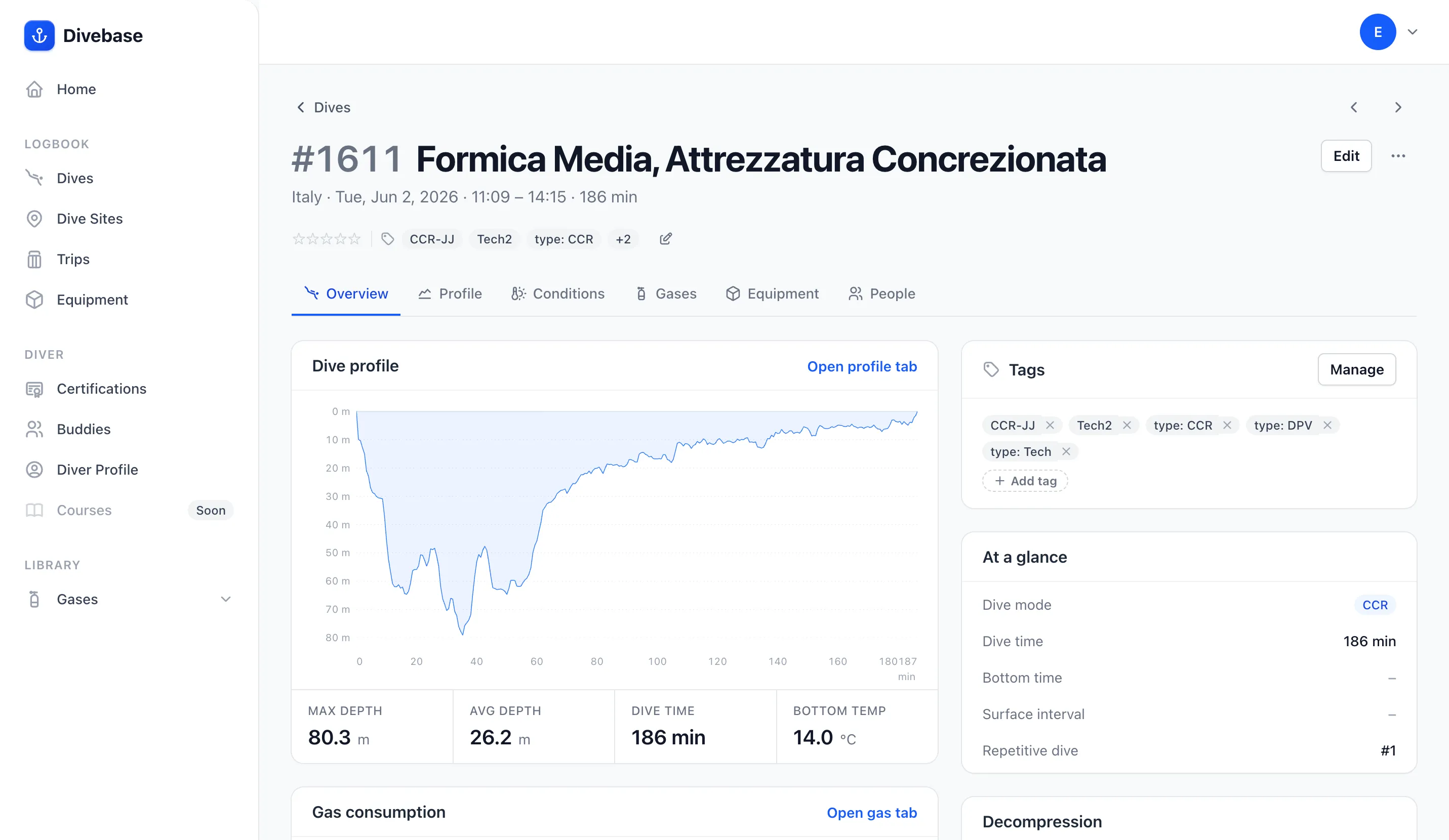
A few days ago I shared the first piece of the dive profile. Today I'm finally presenting the rest: the new dive profile section, built around an interactive dive chart that lets you replay your dive, event by event and condition by condition. It reads the samples your dive computer records at periodic intervals through the dive, tracking depth, temperature, CNS, ppO₂ and much more.

This is one of the features I'm most proud of. I've relied on dive charts for years to review my own dives, for all sorts of reasons: inspecting the profile of a deco dive, working out the best navigation for a site, or debugging my rebreather's ppO₂ and sensor readings. For all of those, and many more, the interactive dive chart is now there for you too.

Read update

Importing your dives from Garmin FIT

A dive imported from a Garmin FIT file in Divebase, its depth-and-time profile filled in

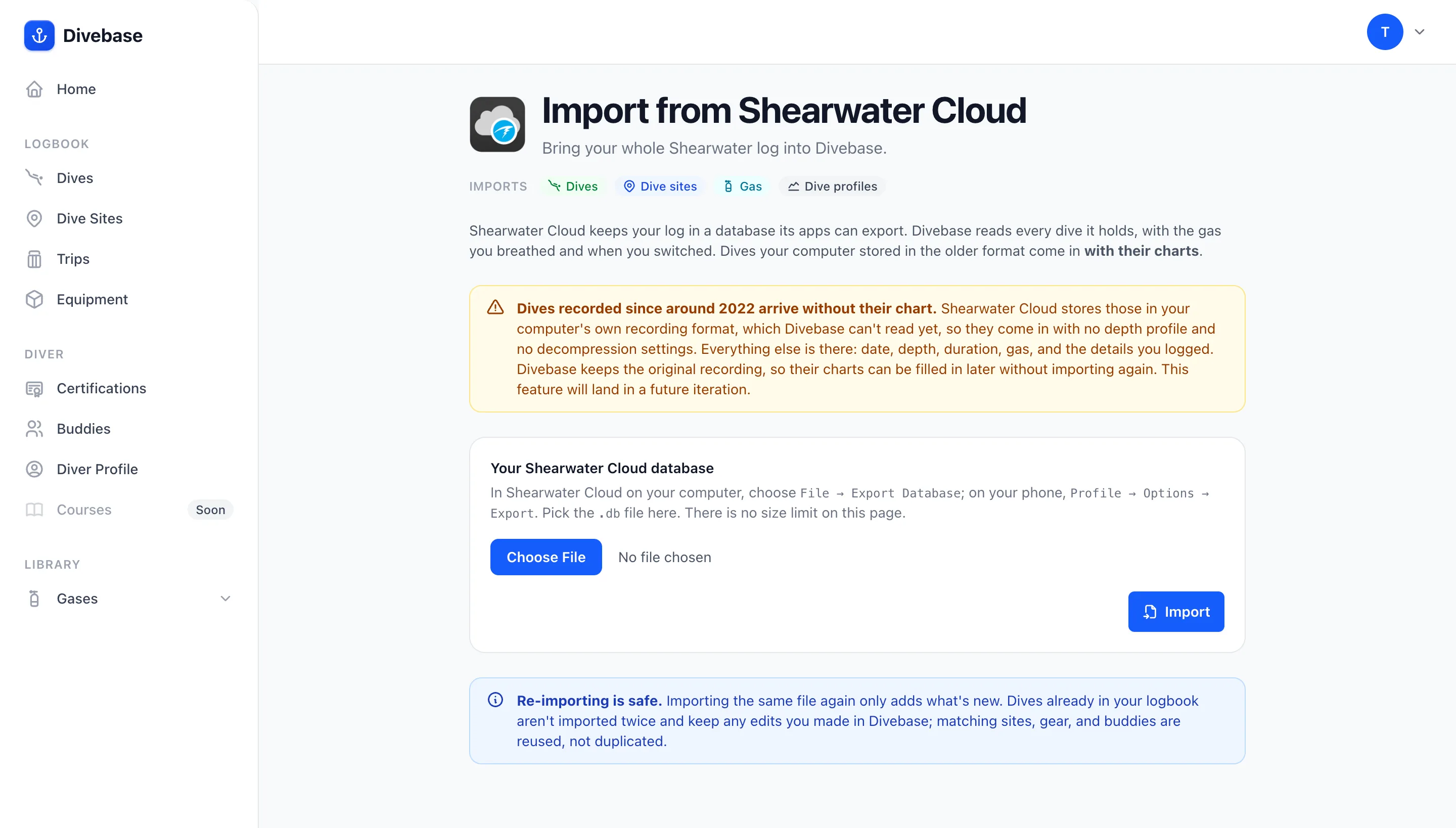
Since we released the UDDF importer, many of you asked to import dives straight from your Garmin dive computers. Garmin dives can't easily be exported to UDDF, but they can be exported to Garmin's proprietary format, FIT.

The Garmin Flexible and Interoperable Data Transfer (FIT) protocol is designed specifically for storing and sharing data from sport, fitness, and health devices. That includes, you guessed it, dives, their dive sites, and their coordinates.

Today we're opening up support for importing dives from Garmin FIT files. Importing a dive from a FIT file doesn't just create the dive; it also populates the dive profile.

Read update

Introducing dive profiles

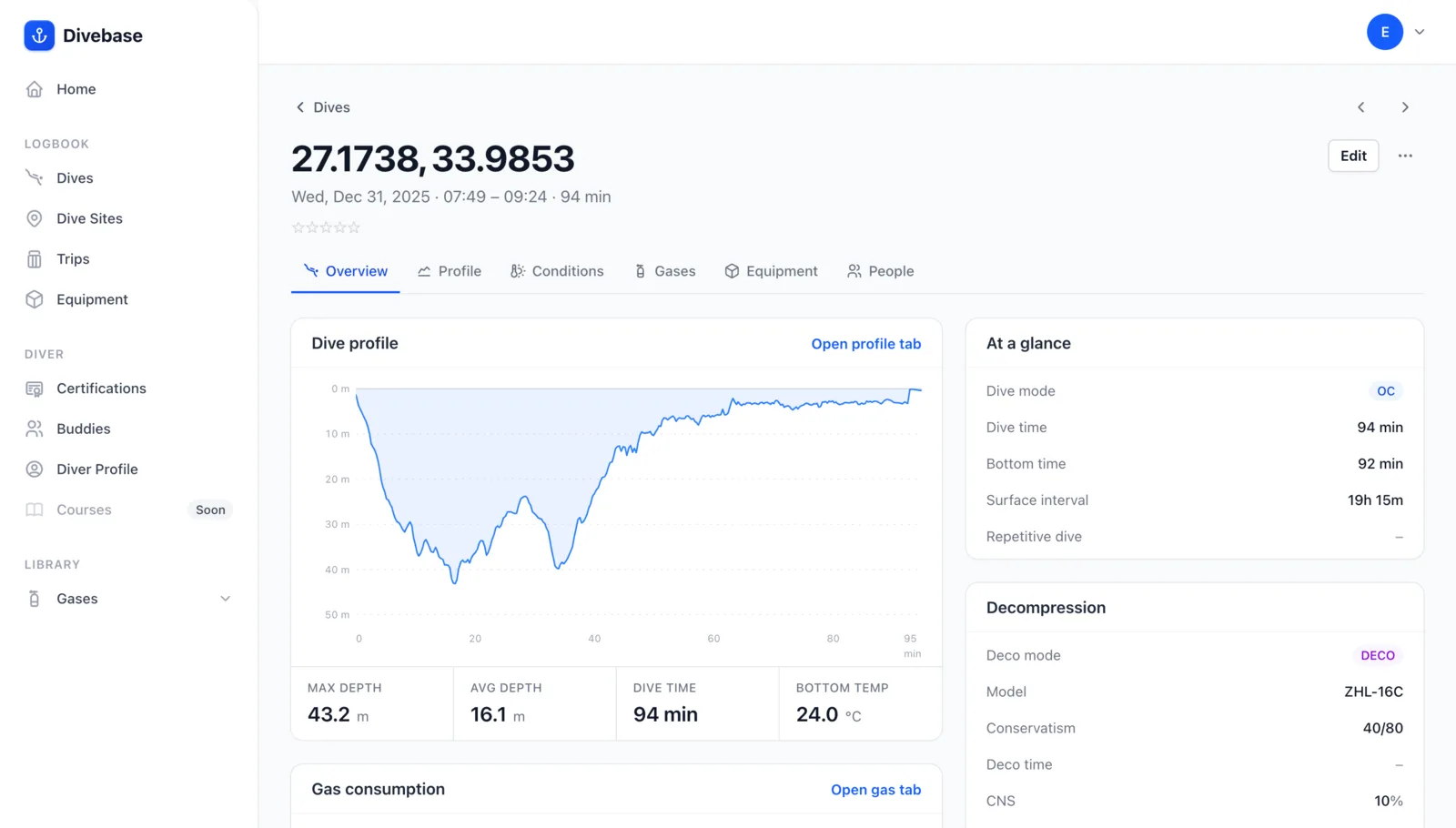
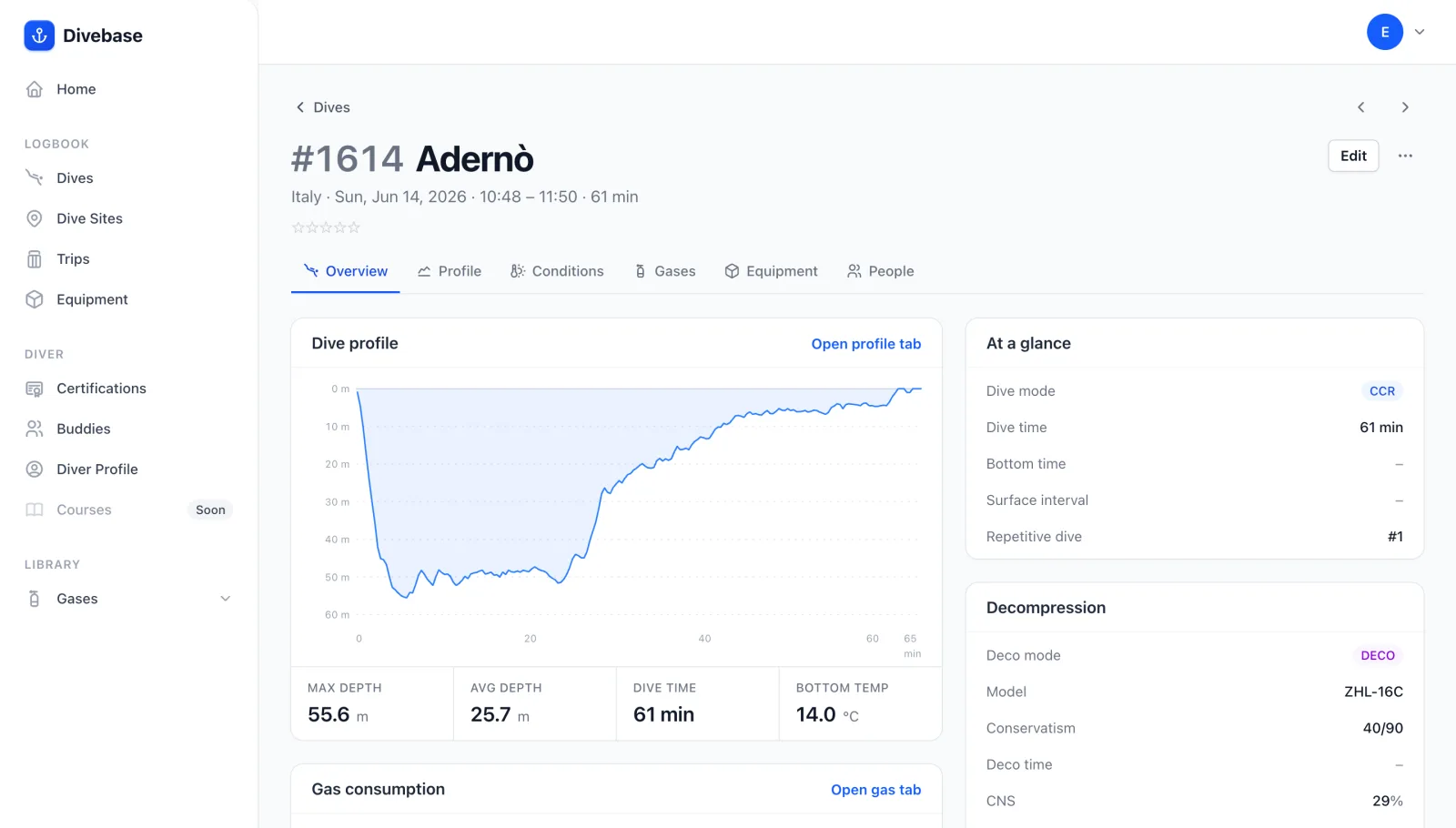
A Divebase dive overview showing the new dive profile preview, tracing depth against time

A dive is more than its deepest point. Today Divebase gains one of its most significant additions yet: the dive profile. A dive profile is the trail of readings your dive computer records at regular intervals through a dive, the data that lets you visualise and replay how the dive actually unfolded.

Dive profiles are made possible by dive computers. Throughout a dive they monitor parameters like depth, time, temperature, and ppO2, and record them into the log at periodic intervals. When you download a dive from your computer you are not just capturing the basics (dive time, duration, maximum depth, temperature); you are downloading a collection of dive samples. Each sample is a snapshot of those readings at a single moment in the dive, and those samples can be put to work later in a number of ways: to plot the dive profile, or to inspect one particular aspect of the dive.

If a dive has a profile attached, the main dive overview now shows a simple dive profile preview, tracing depth against time. It gives you an instant picture of the dive to refresh your memory.

Read update

Introducing dive buddies

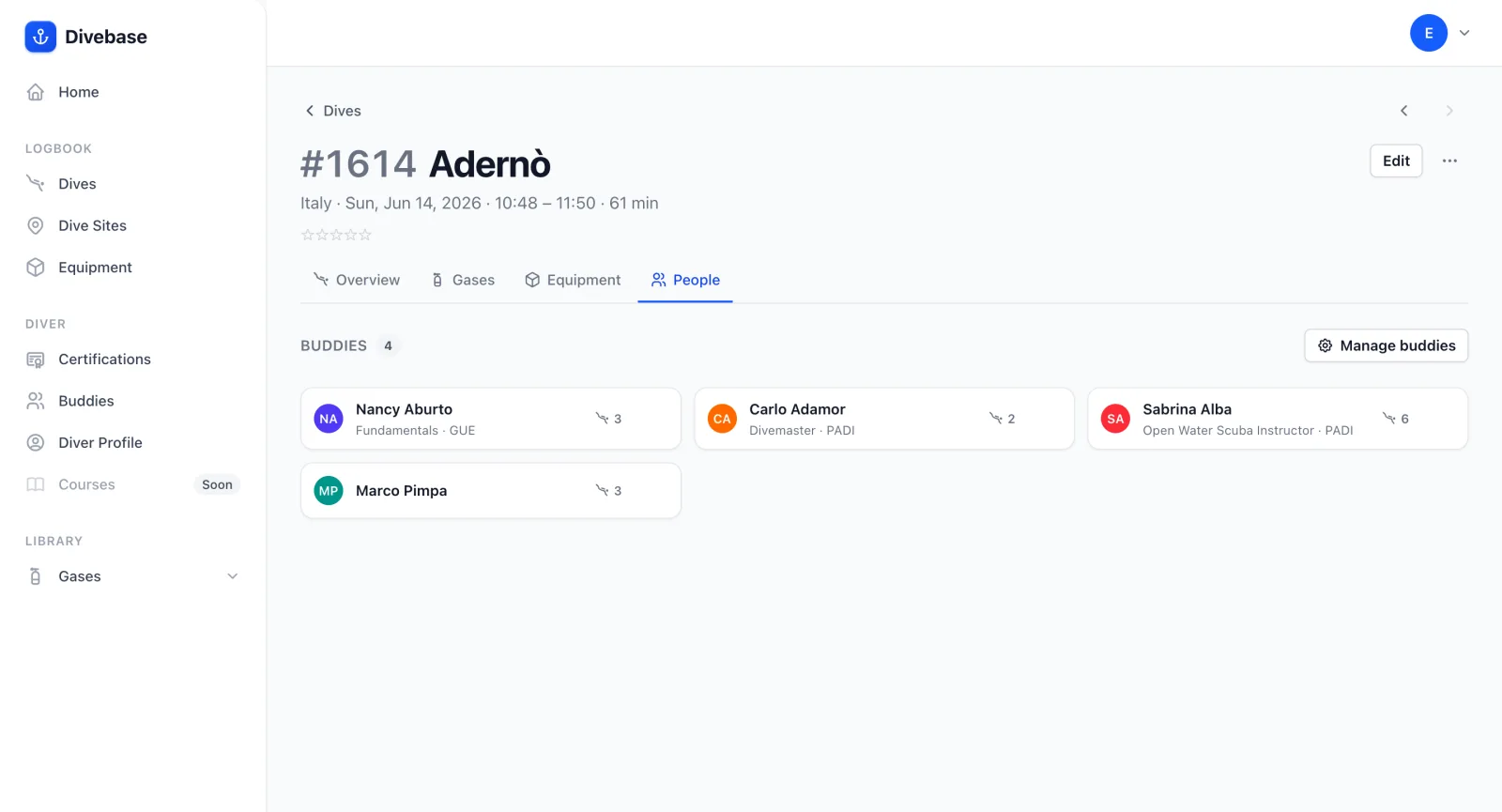
The new People tab on a Divebase dive, listing the dive buddies with a Manage buddies action

Diving is better with friends. And until now, Divebase remembered every dive but not the people you shared it with. That changes today: you can record the buddies you dived with, right inside the app. Open any dive and you'll find a new People tab where you add whoever was in the water with you, the same way you already attach equipment.

Read update

Equipment, dive by dive

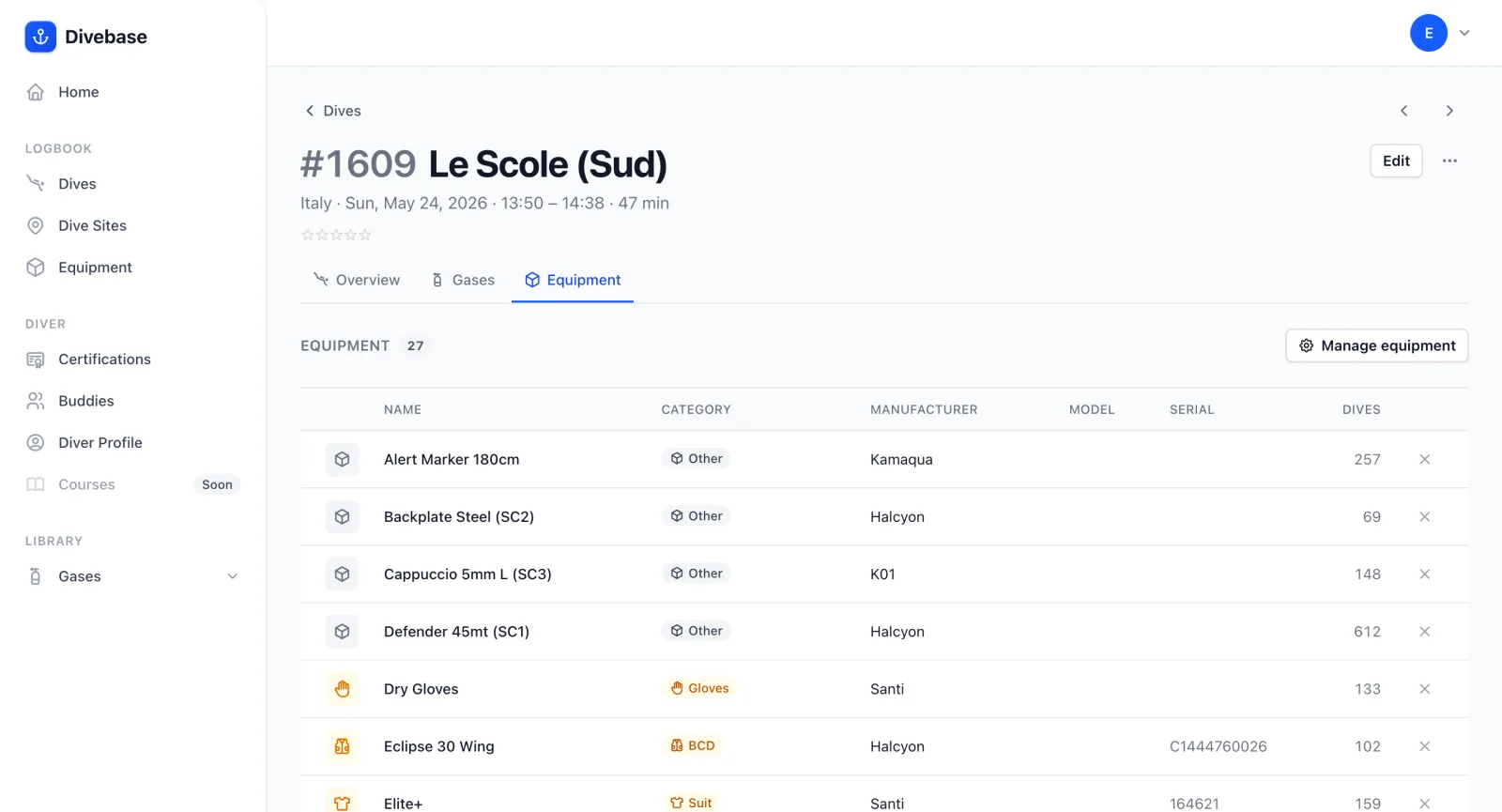
The new Equipment tab on a Divebase dive, listing the gear used on that dive

Every dive has its own kit. Starting today, you can record exactly which gear you took on each dive. It builds on the equipment inventory you already keep in Divebase: the same scuba gear, now connected to the dives where you actually used it.

Open any dive and you'll find a new Equipment tab. It lists the gear for that individual dive, each item with its details, and a click on any entry takes you straight to that equipment's page.

Read update

A wallet for your dive insurances

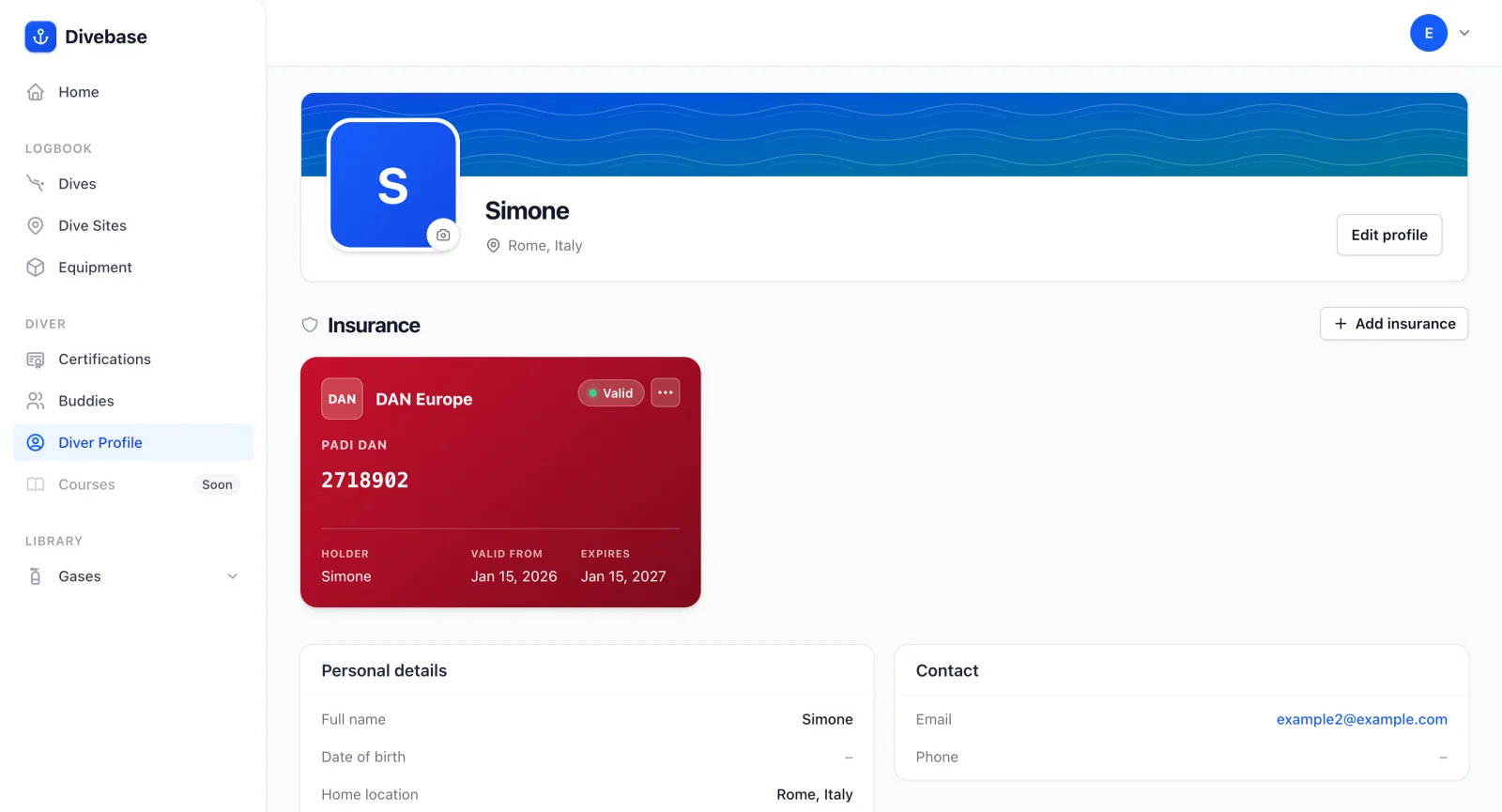
A dive insurance shown as a card in the Divebase diver profile, with its insurer, holder, policy number, and validity period

Some dives ask for more than a certification. Dive professionals like instructors and divemasters need an active insurance policy to stay in teaching status. And plenty of dive activities, trips and liveaboards among them, won't let you join unless you're insured for the duration.

Keeping track of your policies, their numbers, and their expiration dates is something divers are notoriously bad at. Starting today, Divebase tracks them for you, right inside the diver profile.

The new section lets you add each of your dive insurances along with the details that matter: the insurer, the insurance holder, the policy number, and (most importantly) the validity period. Once saved, the insurance shows up as a card in your diver profile.

Read update

Introducing the diver profile

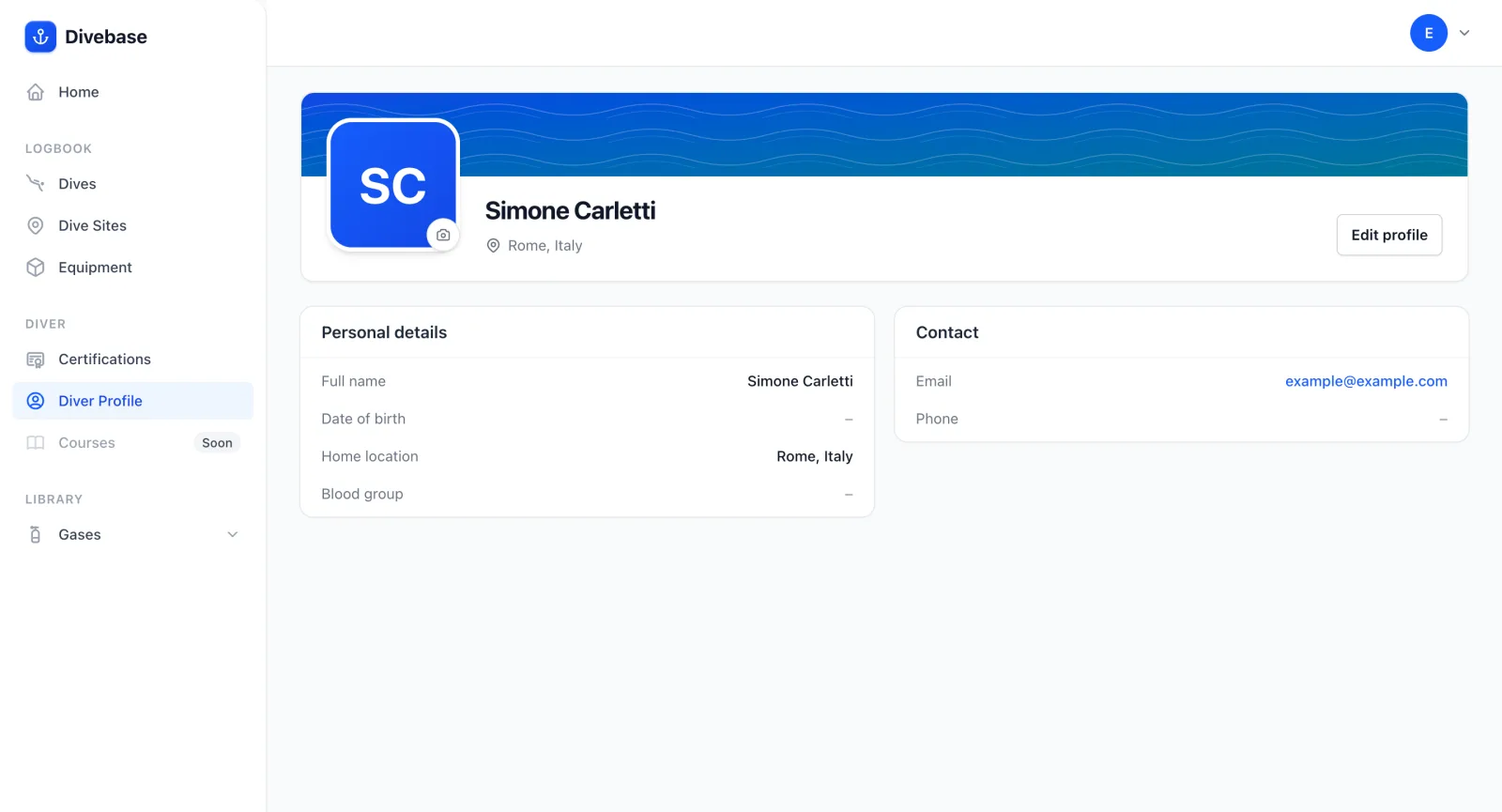
The Divebase diver profile, showing personal details (name, date of birth, home location, blood group) alongside contact details

Who's the diver? You are. And until today, Divebase didn't know the first thing about you. That changes now with the diver profile, a new section that's all about the person behind the logbook. You'll find it in the left sidebar, right where it used to sit with a quiet "SOON" tag beside it.

The profile is where you introduce yourself. Tell Divebase your name and date of birth, where you call home, and a little more if you like: a contact email and phone, kept separate from your account login, and your blood group.

Read update

Grading dive site difficulty

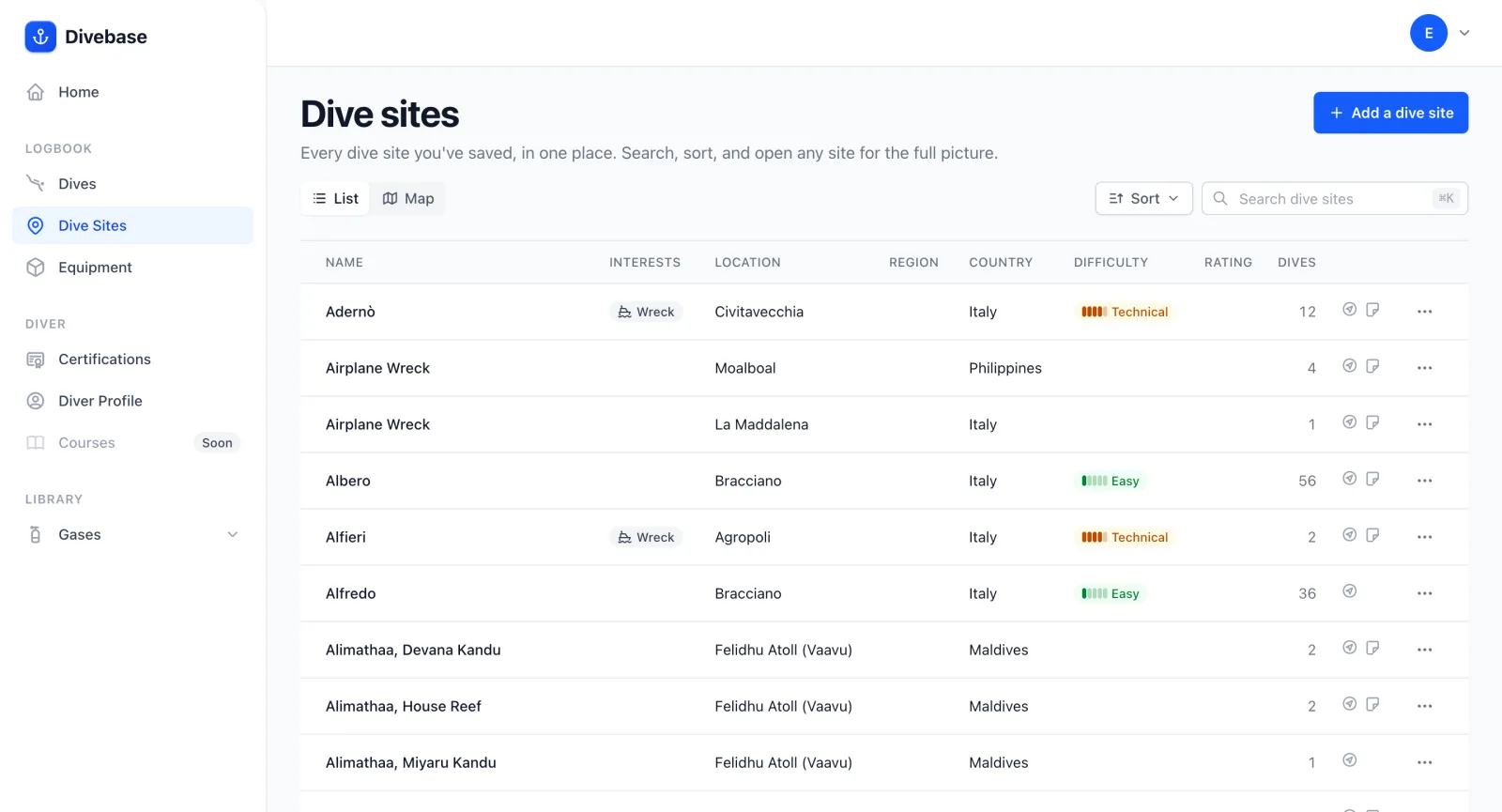
The Divebase dive site list, each site showing its difficulty level beside its name

Not all dive sites are equal. Some are more interesting than others, which is exactly why you can tag them by interest. And some are simply easier, or harder, to dive than others. So now you can grade your dive sites by difficulty too.

Difficulty is a single value on a scale from 1 to 5, where 1 is the most accessible and 5 the most specialized:

  1. Easy: calm, shallow, forgiving conditions any certified diver can enjoy.
  2. Intermediate: a little more depth or current, comfortable once you have a few dives behind you.
  3. Advanced: depth, current, or conditions that reward genuine experience.
  4. Technical: beyond recreational limits, the kind of site that calls for technical training and gear.
  5. Special: the most demanding sites, reserved for divers with the specific training they require.
Read update

Announcing the Divebase API

This might be the most important update since Divebase began. Today I'm unveiling the Divebase API: a REST API that lets you connect to Divebase and manage your whole logbook in code, from your dives and dive sites to your equipment, certifications, cylinders, and gas mixes.

That single change turns Divebase into a platform: a true dive database that anyone can read from and write to. Your logbook stops being something locked inside one app and becomes something you can build on.

Read update

Your dive sites on an interactive map

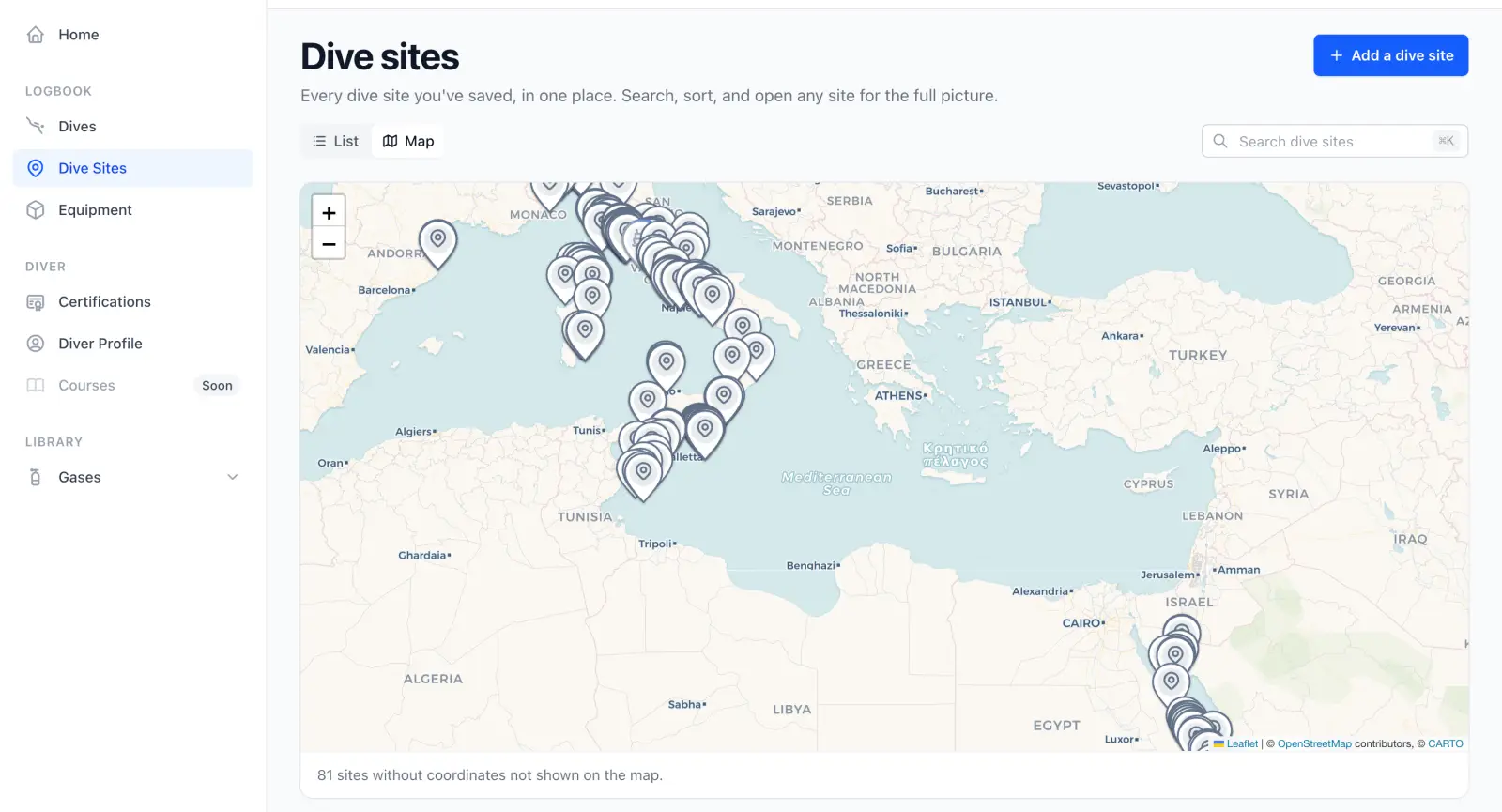
The Divebase dive sites map, every saved site plotted across the Mediterranean with a search box above the map

A map is one of my favourite ways to make sense of a place. Frequent travellers know the feeling, and scuba divers doubly so: half the joy of keeping a dive log is showing off where you've actually been underwater.

You've been able to drop your dive sites on a map for a while now. This update gives that map a promotion: every dive site in your logbook sits on one interactive map, and it searches and filters exactly like the rest of your listings. Type a name, narrow the list, and the map keeps pace with whatever you're looking for.

Read update

Tracking dive site interests

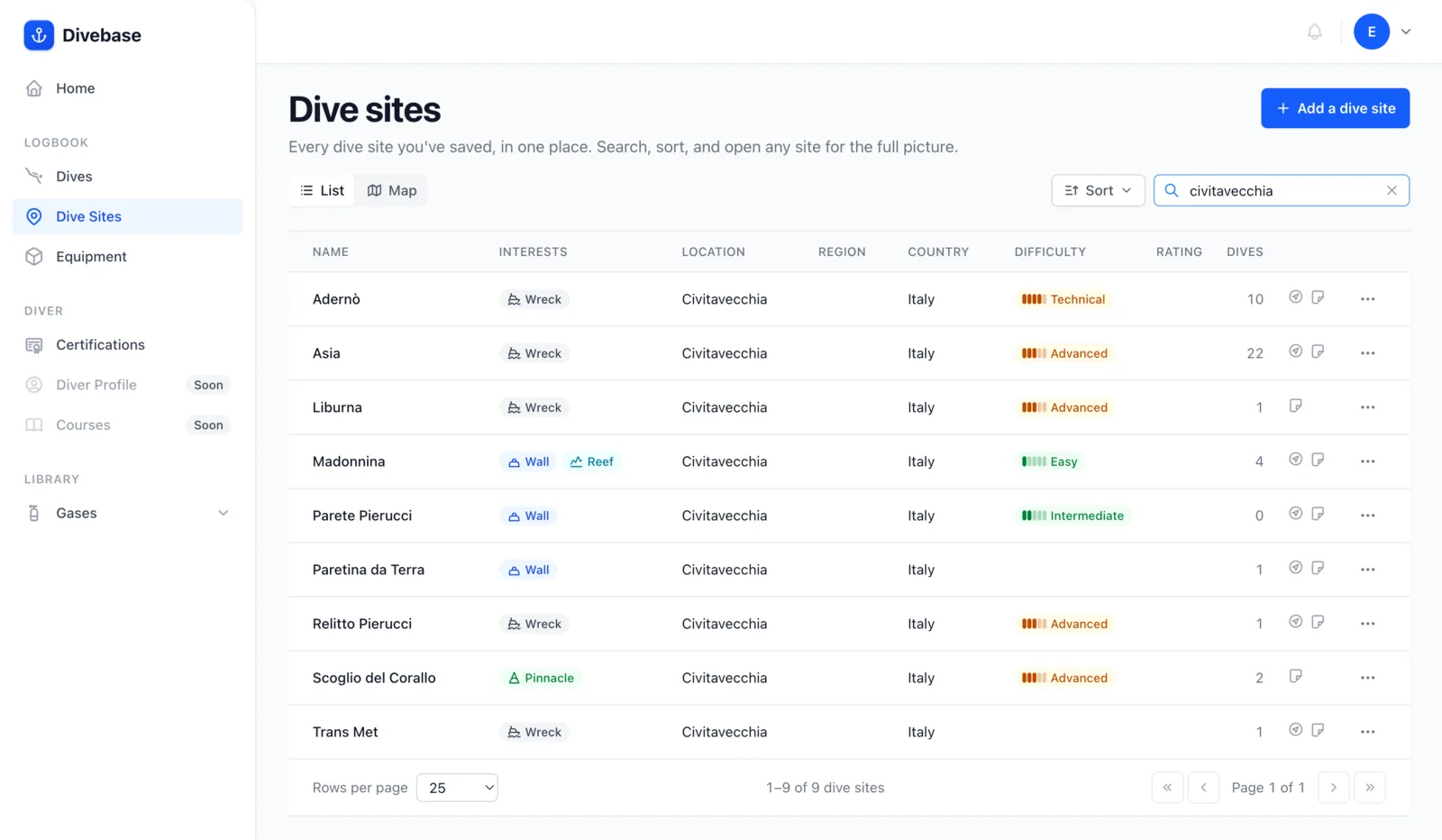
The Divebase dive site list, each site's interests shown as chips beside its name

Not all dive sites are equal. Each one has its own character: what you came to see, and the reason you planned the dive in the first place. Today I'm rolling out a change that lets you capture exactly that, by adding interests to any dive site.

An interest is a short, deliberate label for what a dive site is known for. The catalogue is intentionally small: a finite, easy-to-scan classification rather than an overwhelming pile of tags. In this first version there are five:

  • Wreck: sunken ships, planes, statues, or any artificial structure on the bottom.
  • Cave: any overhead environment, from caverns and tunnels to swim-throughs and full caves.
  • Pinnacle: an underwater spire or seamount rising from a deeper bottom (what Italian divers call a secca).
  • Wall: a vertical or near-vertical drop-off.
  • Reef: coral, rocky reef, or boulder fields.

Interests show up in your dive site list, right next to the name, so the kind of dive is obvious at a glance.

Read update

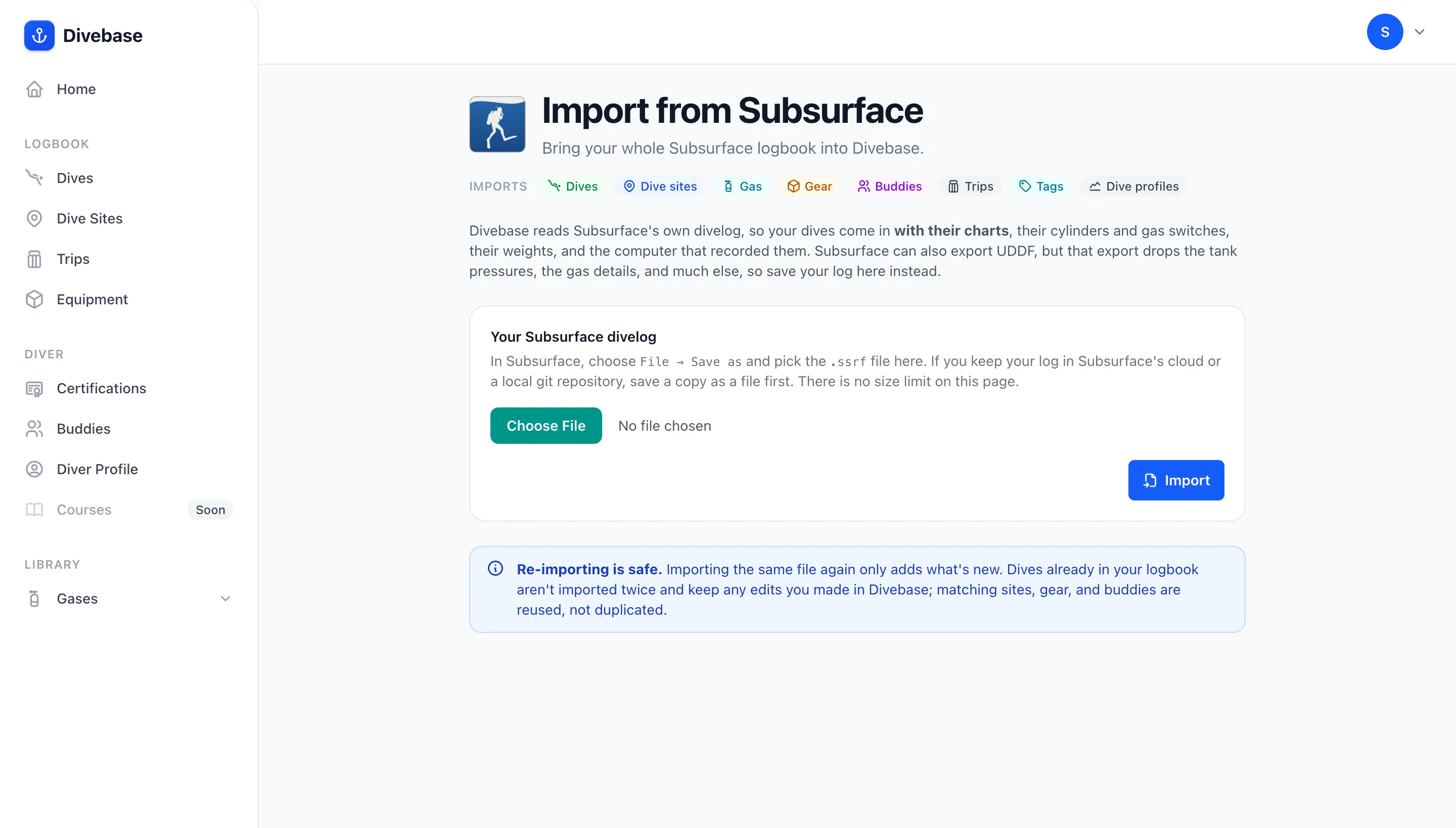
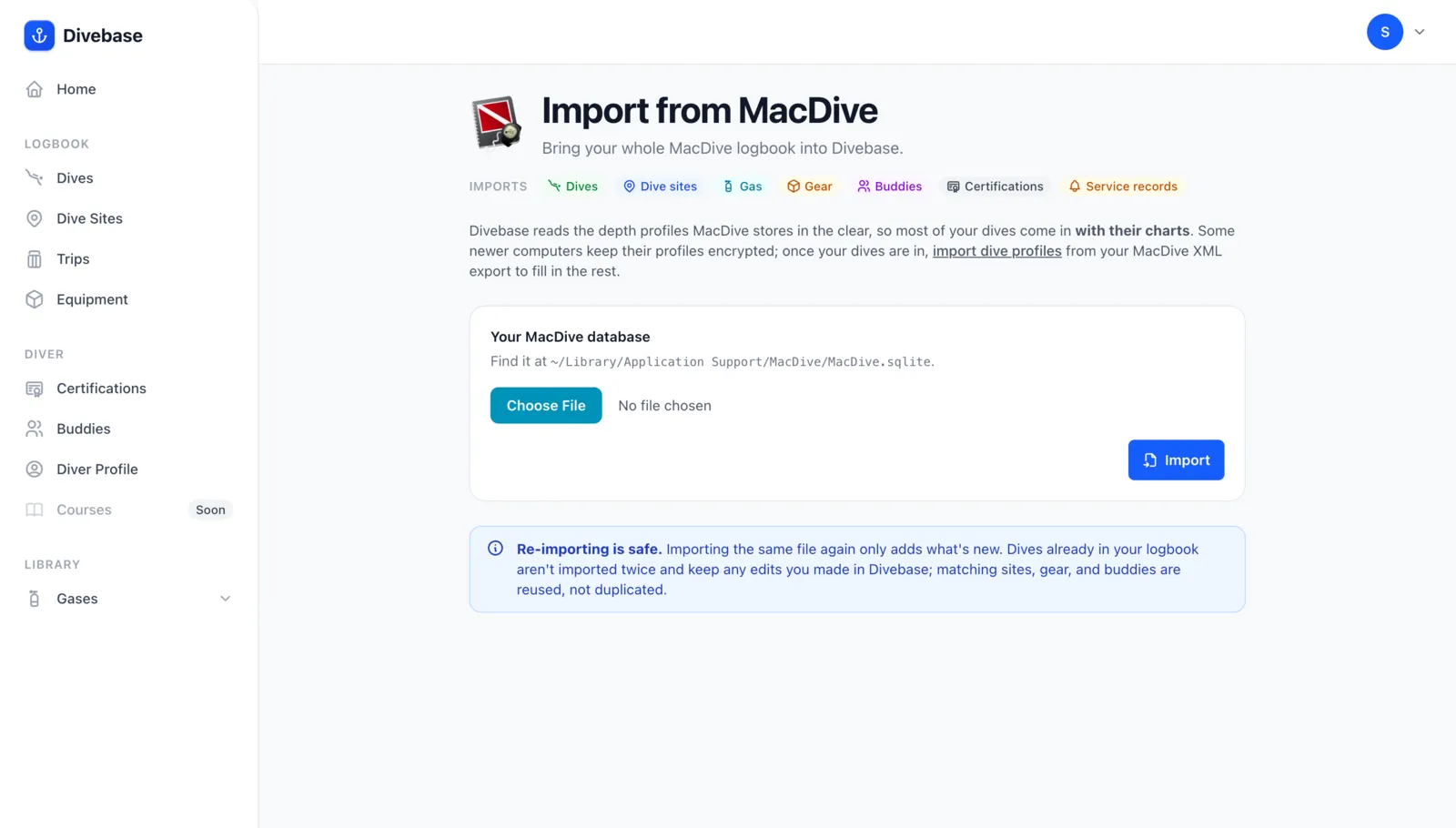
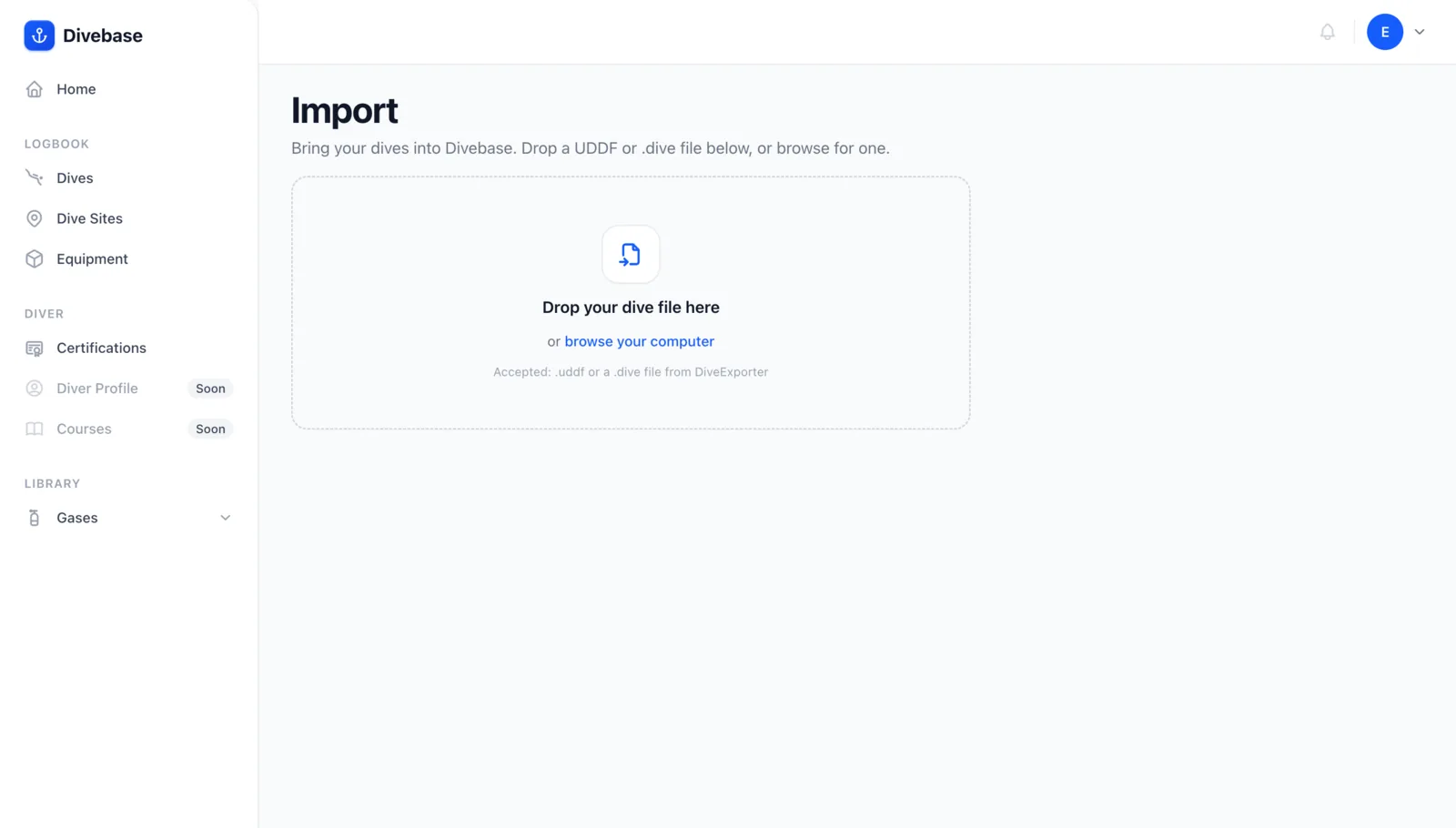
Importing your logbook dives via UDDF

The Divebase Import screen, with a drop zone for a UDDF or .dive file

Diving is fun. Visualizing your dive sites is fun, browsing your dive log history is fun... but manually typing every dive into your logbook? Not fun. We hear you.

When I started building a divelog, I knew nobody would use it unless there was an easy, convenient way to bring their existing dives in. Dives come from many sources and in many formats, and one of the most widely adopted is UDDF, the Universal Dive Data Format.

UDDF files aren't just for dive entries. They're little databases in their own right: a single file can carry your dives, but also the associated dive sites, your equipment, your diver certifications, and more.

Divebase now imports UDDF files. Today we pull out the dive list, the dive sites, the dive details, the per-dive gas usage, and even the dive samples, enough to build an initial version of the dive profile and to surface useful decompression information: the dive computer model, the gradient factors or conservatism setting, and so on.

Read update

Tracking the gas you breathe, dive by dive

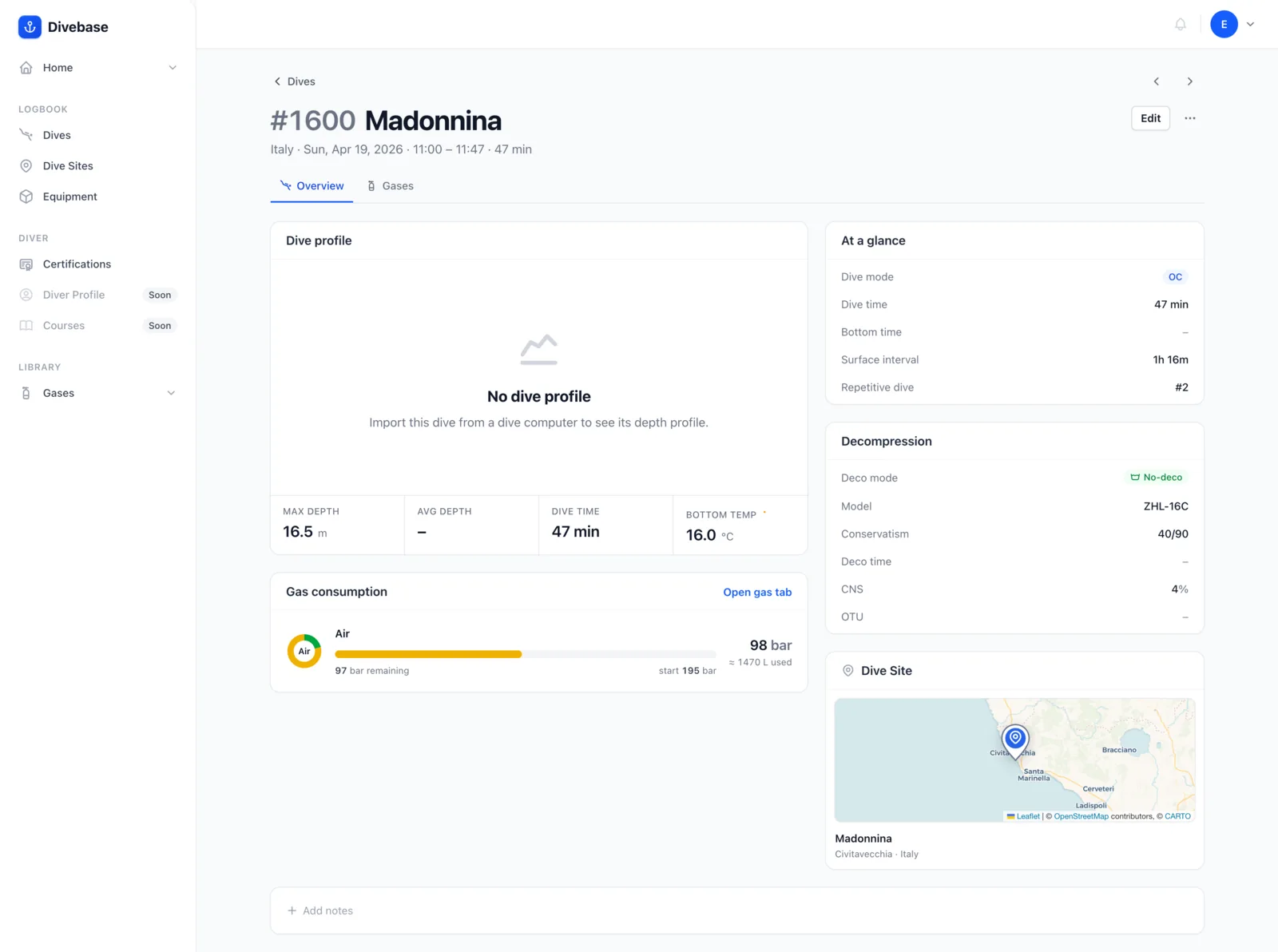
A Divebase dive Overview with its new Gas consumption panel, summarizing each tank and mix breathed

You can build your gas mixes, you can define your cylinders, and the obvious next step writes itself: putting the two to work on an actual dive. A mix tells you what you breathed and a cylinder how much you carried; pair them on a dive and Divebase can finally answer the question every logbook dances around, how much gas did you actually use?

A new Gas consumption panel now rides in your dive's Overview. It's the summary view: every tank and mix you breathed on the dive, each with its blend, a pressure gauge, and the gas you got through.

Read update

Introducing cylinder management

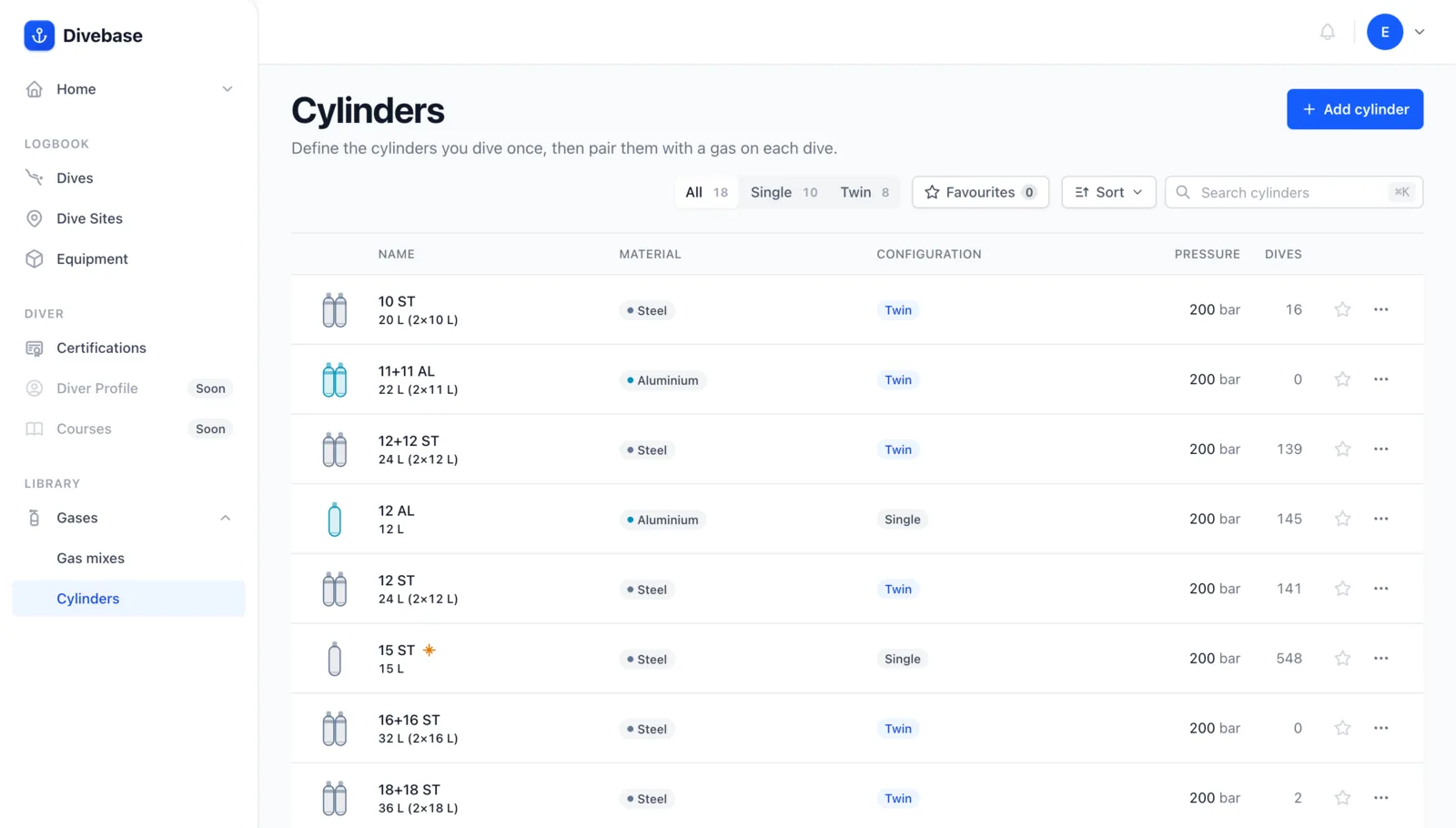
The Divebase cylinders list, every tank you own in one place

Last time I introduced gas mixes and promised the other half of the Gases section. Here it is: cylinders. A gas mix tells you what you breathe; a cylinder tells you how much of it you carry, and the two belong together.

So why bother defining your tanks at all? Two good reasons, and a third for the gear nerds.

Read update

Introducing gas mixes management

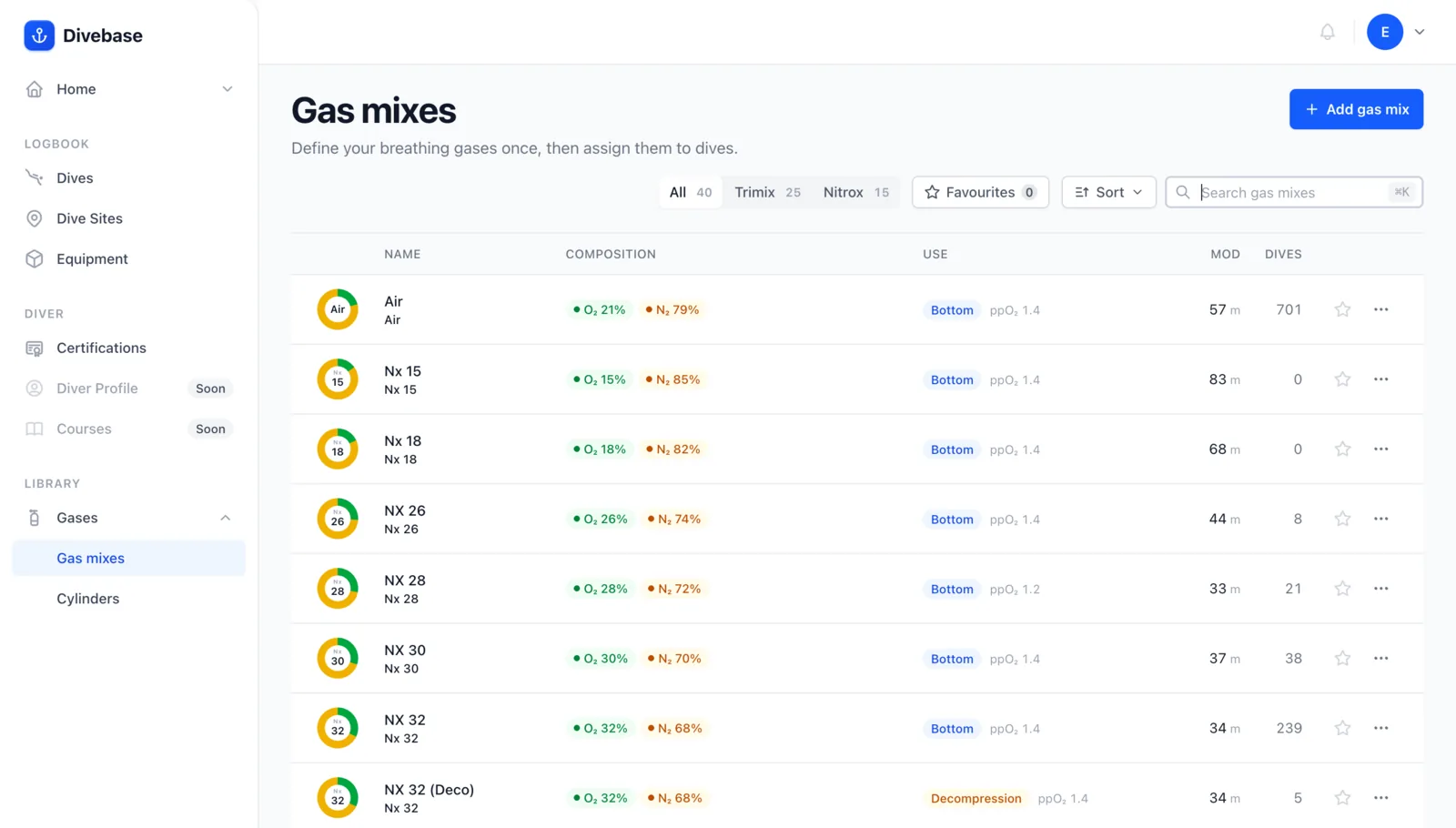
The Divebase gas mixes list, every blend you breathe in one place

I've said before that a dive holds more detail than anything else in a logbook. That's no accident: the dive is the center of every diving experience, as we explored last time. And that experience takes many forms, from open circuit to rebreather, each with its own way of feeding you the gas you breathe.

The sidebar now carries a new section: Gases. It has actually been hiding in a few earlier screenshots, quietly under construction, and it's finally ready. It manages two essentials: gas mixes and cylinders. Let's start with gas mixes; cylinders get their turn in a later update.

Read update

A divelog for open circuit, rebreather, apnea, and more

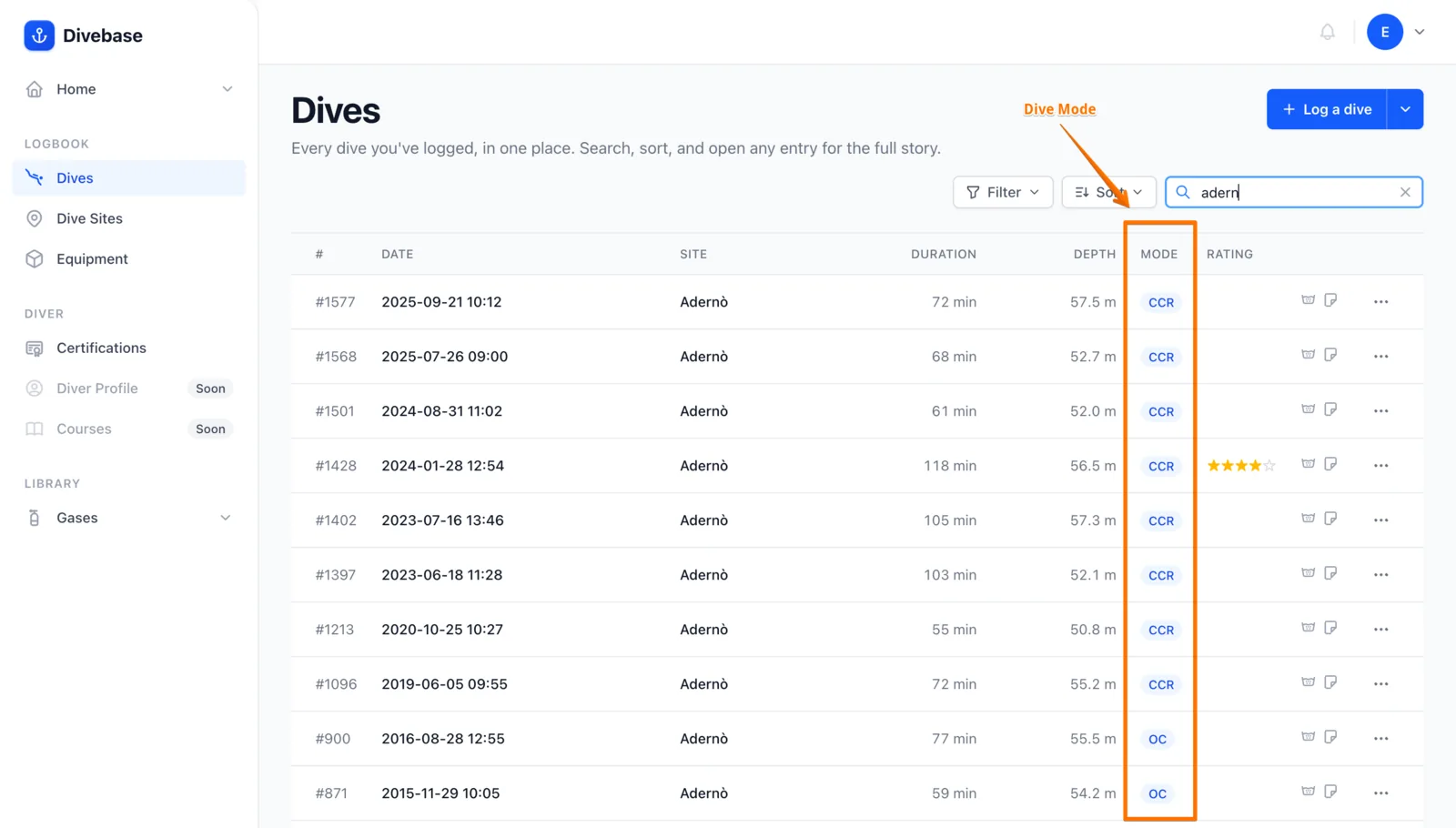
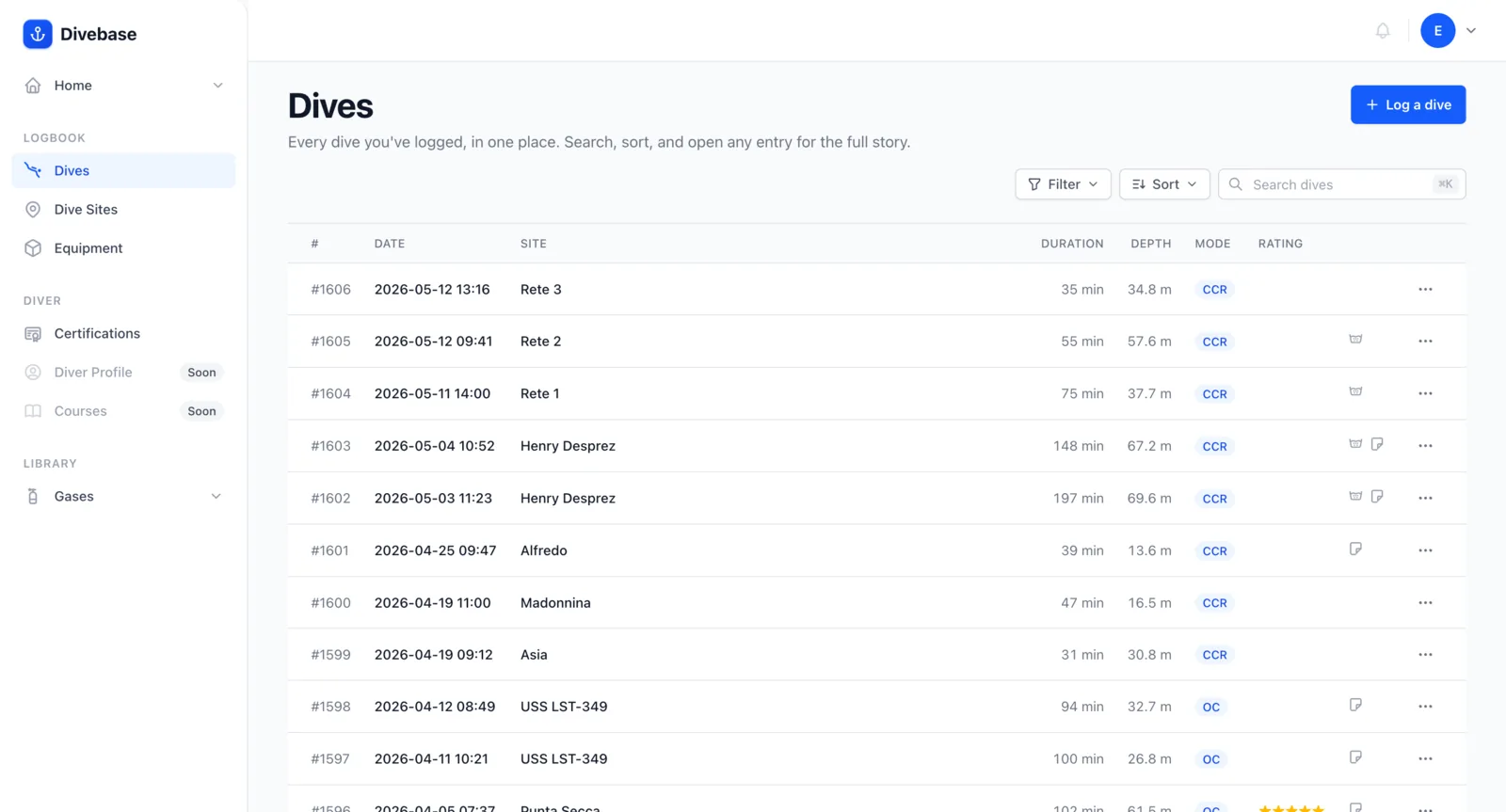
The Divebase dive list, each dive's mode shown alongside its date, site, depth, and duration

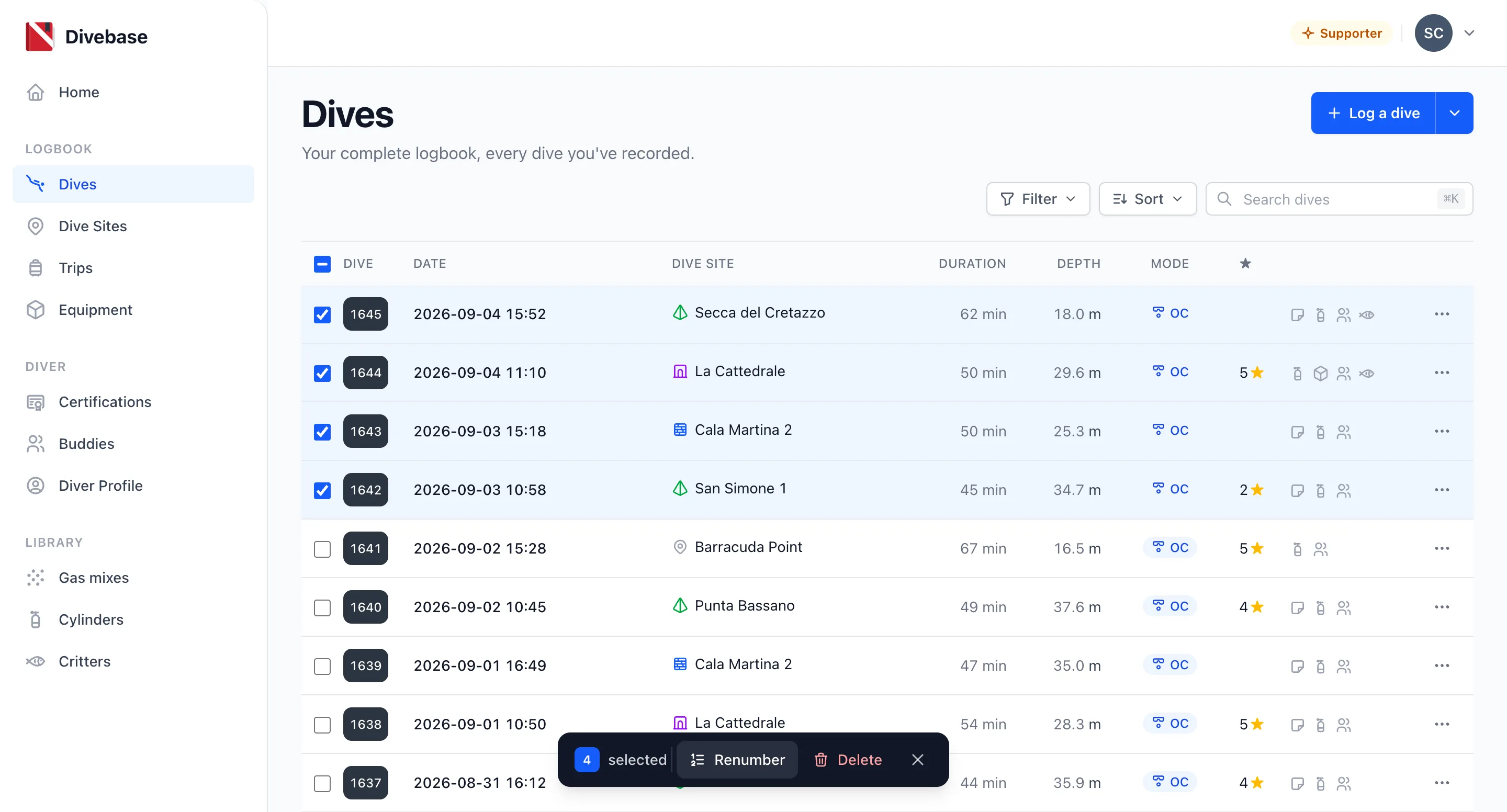
Not every dive is the same kind of dive. Today I want to highlight a quieter feature of the Divebase logbook: the ability to record how you dived, not just where and how deep.

We call it the dive mode, and right now it understands five:

  • Open circuit: regular scuba. You breathe from the tank and your exhaust bubbles up into the water. The familiar default most of us started with.
  • Closed circuit: a closed-circuit rebreather (CCR). It recycles your breath, scrubbing out the CO₂ and topping up the oxygen, so almost nothing leaves the loop.
  • Semi-closed circuit: a semi-closed rebreather (SCR). The middle ground, recycling part of the gas and venting the rest.
  • Gauge / bottom timer: the computer steps back and acts purely as a depth gauge and timer, tracking no gas at all. A staple of technical diving.
  • Freedive / Apnea: breath-hold diving. No tank, no gas, just one breath and the blue.
Read update

Your diving equipment inventory

The Divebase equipment list, every piece of gear in one sortable view

Every diver loves their gear. It's a love-hate relationship: the further you get in your diving, the more equipment you end up buying. Believe me, there's no finish line to this race.

After a few years you own dozens, sometimes hundreds, of pieces: suits, regulators, gloves, BCDs, tanks, and on it goes. A lot of it needs upkeep, and, just like your certifications, it pays to know when each piece is due for a service.

Read update

A wallet for your dive certifications

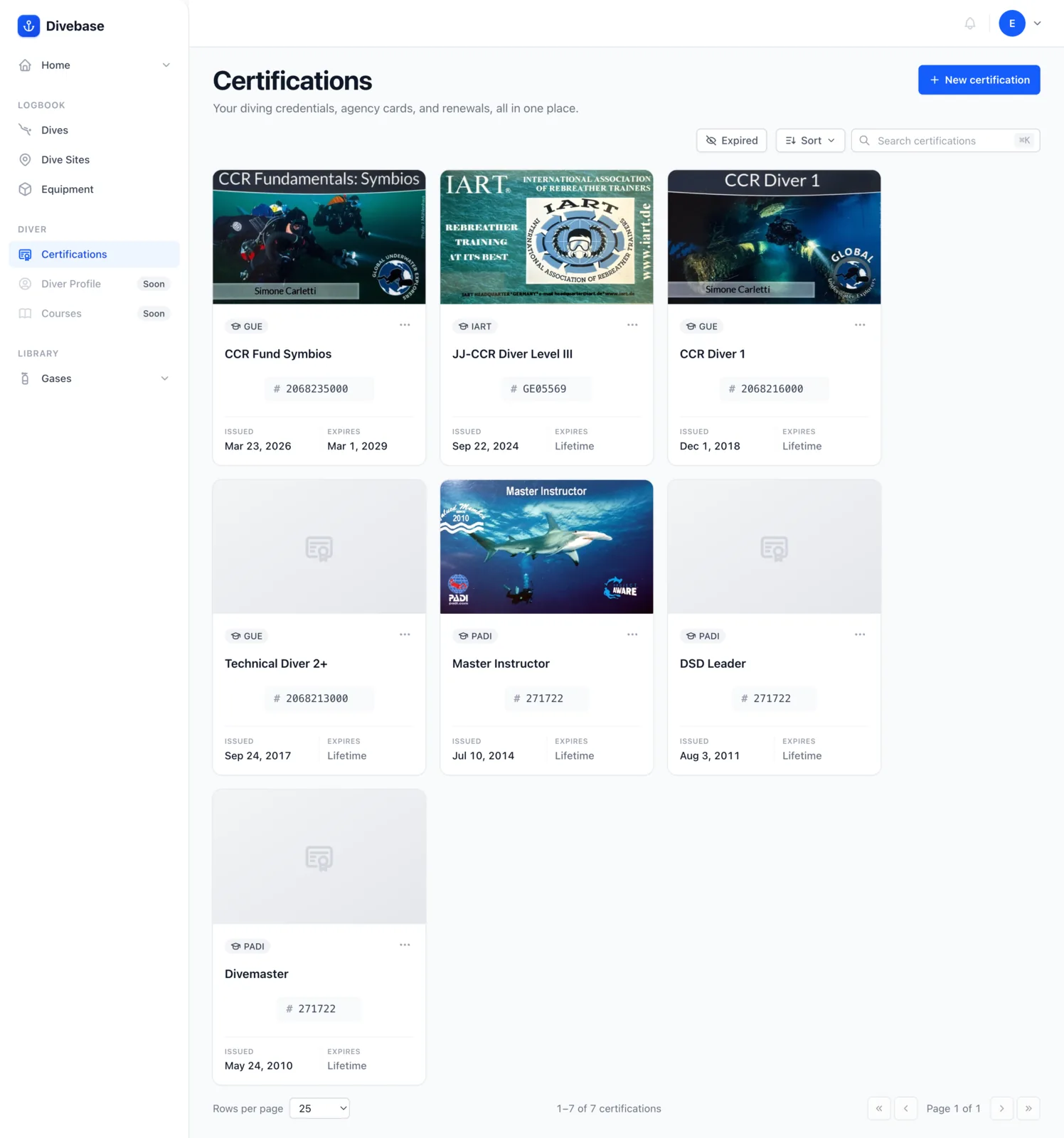
The Divebase certifications page, each credential a card with its agency, number, and dates

As a diver, one question follows me everywhere. What's your current certification? And, more often than not: what's the certification number? You've felt it too. You reach a dive center, or you finally step aboard the liveaboard, you can't wait to get in the water, and first there's the paperwork. And you need that number.

I've tried everything. A photo of the card on my phone, a line in my notes... but every time I ended up back where most of my diving already lives: my dive log software. MacDive let me keep every certification in one place, and I loved it for that.

So when I started Divebase, certifications were the very first thing I built. Before dive sites, before dives, before anything else. Here's how they come together today.

Read update

Your dive site collection

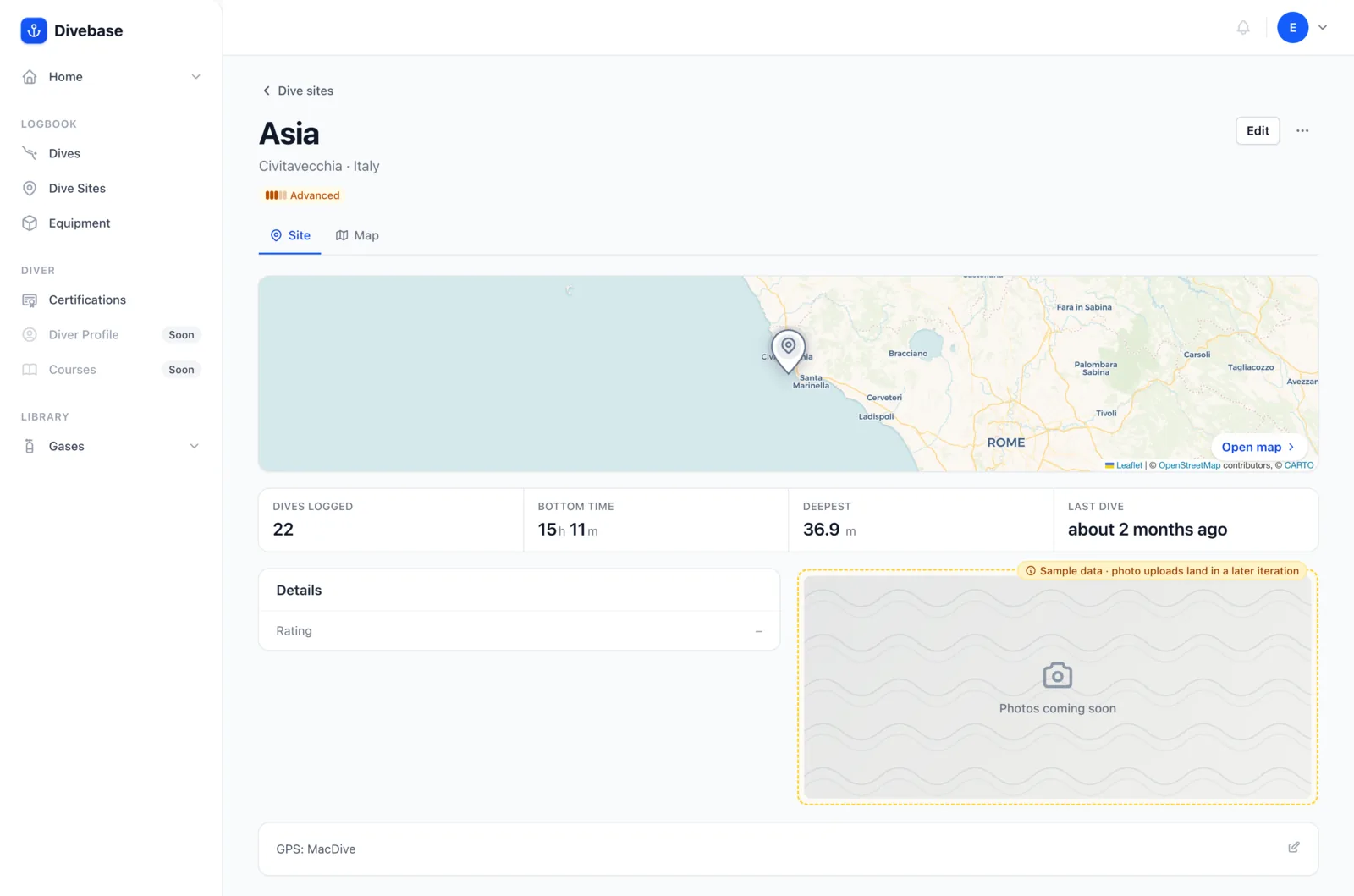
A dive site in Divebase, with its name, location, country, and a pin on the map

Every dive happens somewhere. In the last update you probably didn't miss that little box with a map, pointing at where the great Henry Desprez was sunk. That is what we call a dive site, and this time it gets the spotlight.

Dive sites are first-class citizens in the Divebase dive log. Here's a first look at how you collect them, describe them, and find them on a map.

Read update

Diving into the details

The Divebase dive list, with side icons surfacing each dive's key traits

Dives are the heart of any logbook. They're not only the information you'll come back to most, they're also the hardest to organize. A single dive carries an overwhelming amount of detail: the time, the dive site, the depth, the temperature... you name it.

We spent a good number of hours iterating on a design that strikes a reasonable balance between readability, density, and completeness. What you see today is just the tip of the iceberg, with plenty more still to come. Here's a quick preview of where things stand.

Read update

Welcome to Divebase

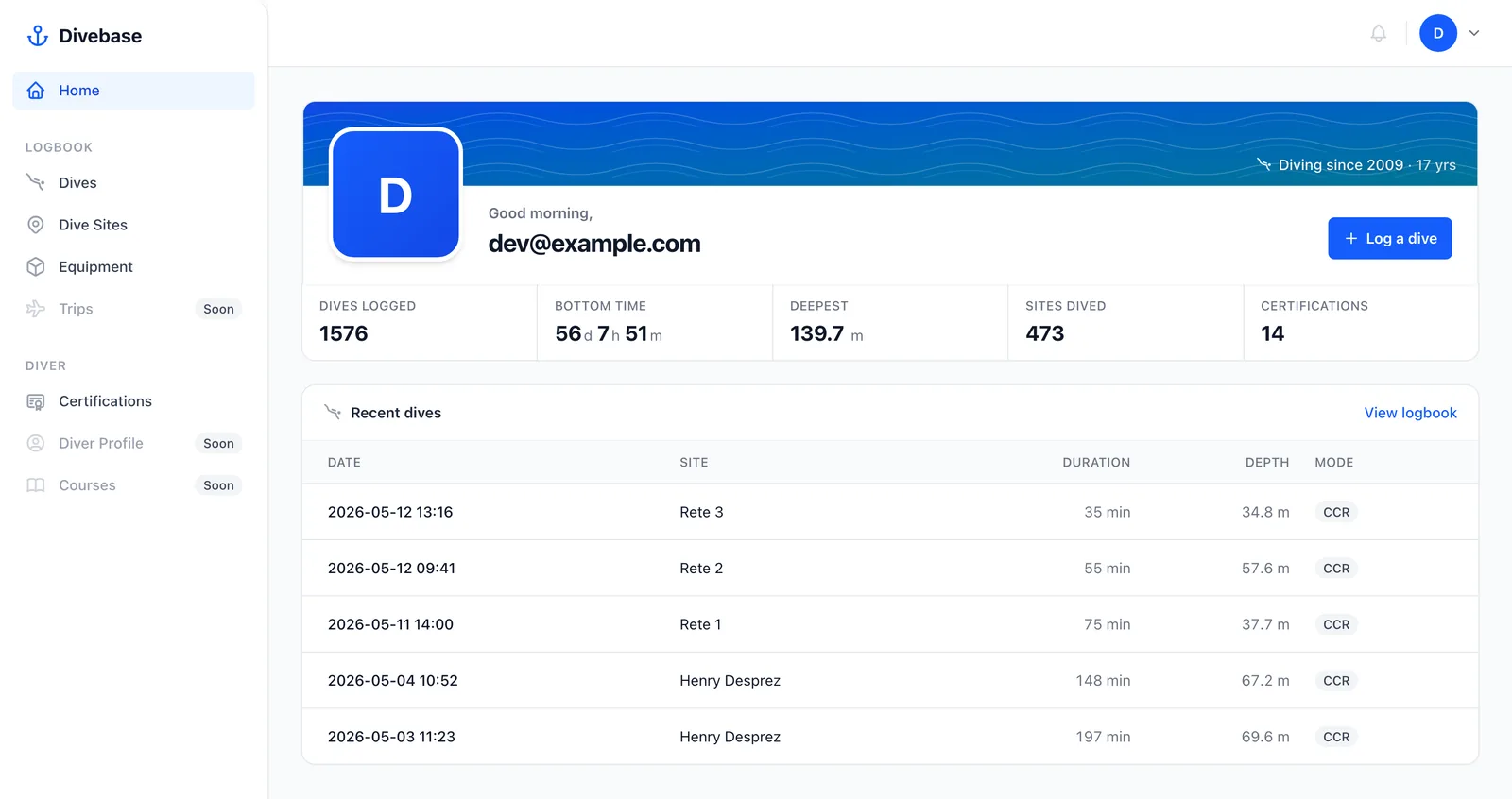
The Divebase home dashboard, showing diver stats and recent dives

Every diver remembers their first descent: that moment you stop floating around on the surface and actually go somewhere. Divebase is at exactly that point. We've left the boat, the water's clear, and there's a whole lot to explore below. 🤿

This is the very first entry in what we hope becomes a long logbook of updates. Here's a work-in-progress peek at where things stand today. The app is still finding its sea legs, but the data you see below is no mockup: it's my own logbook, gathered over 17 years of diving.

Read update