
Small updates - Part 1
Not every change deserves a post of its own. Most of what I write here is about one feature at a time, because most features need the room. But between the big ones, a steady trickle of smaller improvements lands too: a control that got easier to use, a field that turned up in the API, a count that appeared where there wasn't one. They rarely get a mention, and some of them are the kind of thing you'd want to know about.
So this is a different kind of post: a round-up. One short section per change, in rough order of how much I think you'll care.
Search for a dive site from the dive form
Picking a dive site when logging a dive was, until now, a plain dropdown: every site you own, alphabetically, names only. That's fine with twenty sites. With a few hundred, it's a scroll through the whole list to find the one you want, and when two sites share a name (there is more than one "House Reef" in the world, and more than one in my logbook) the list gives you no way to tell them apart.
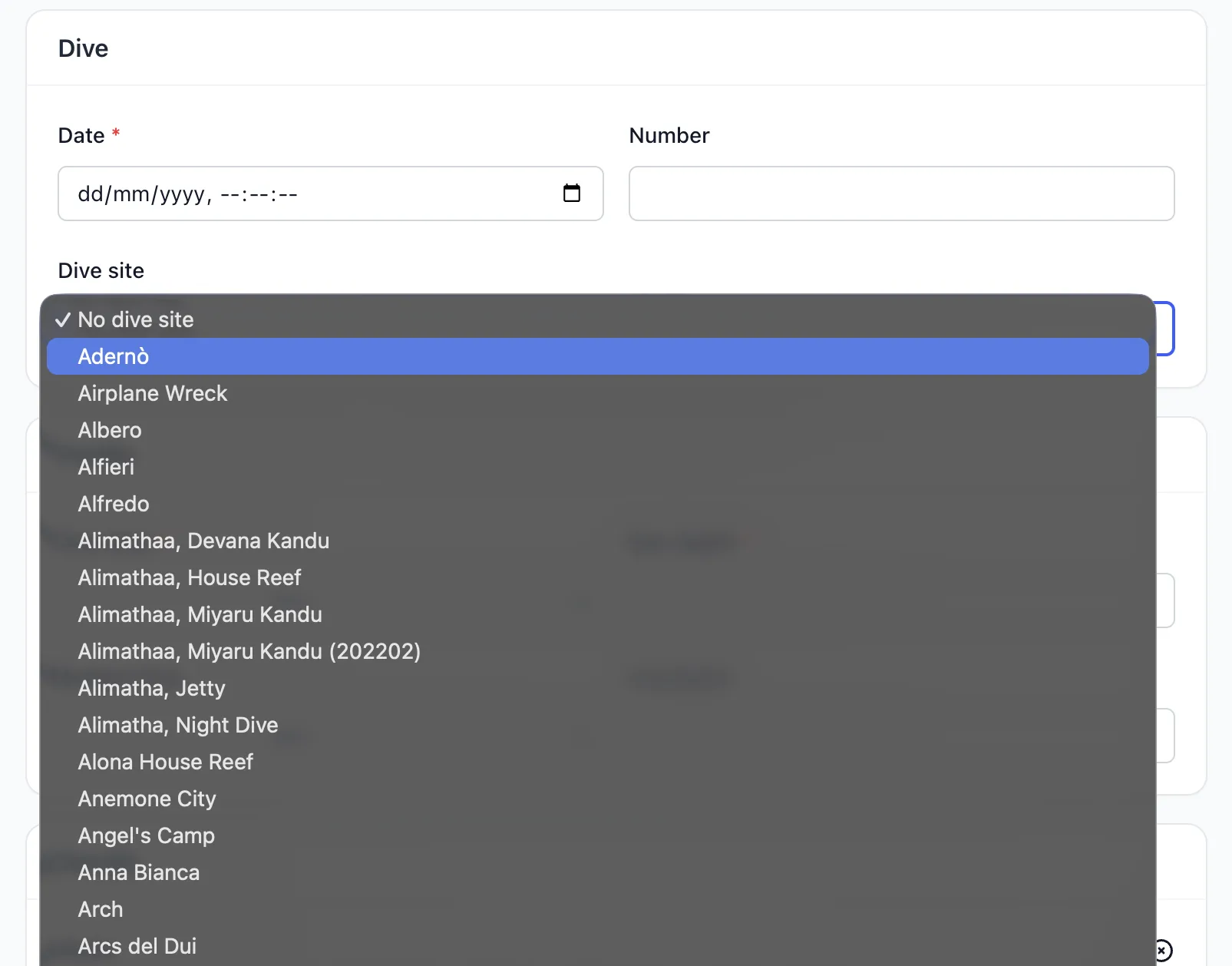
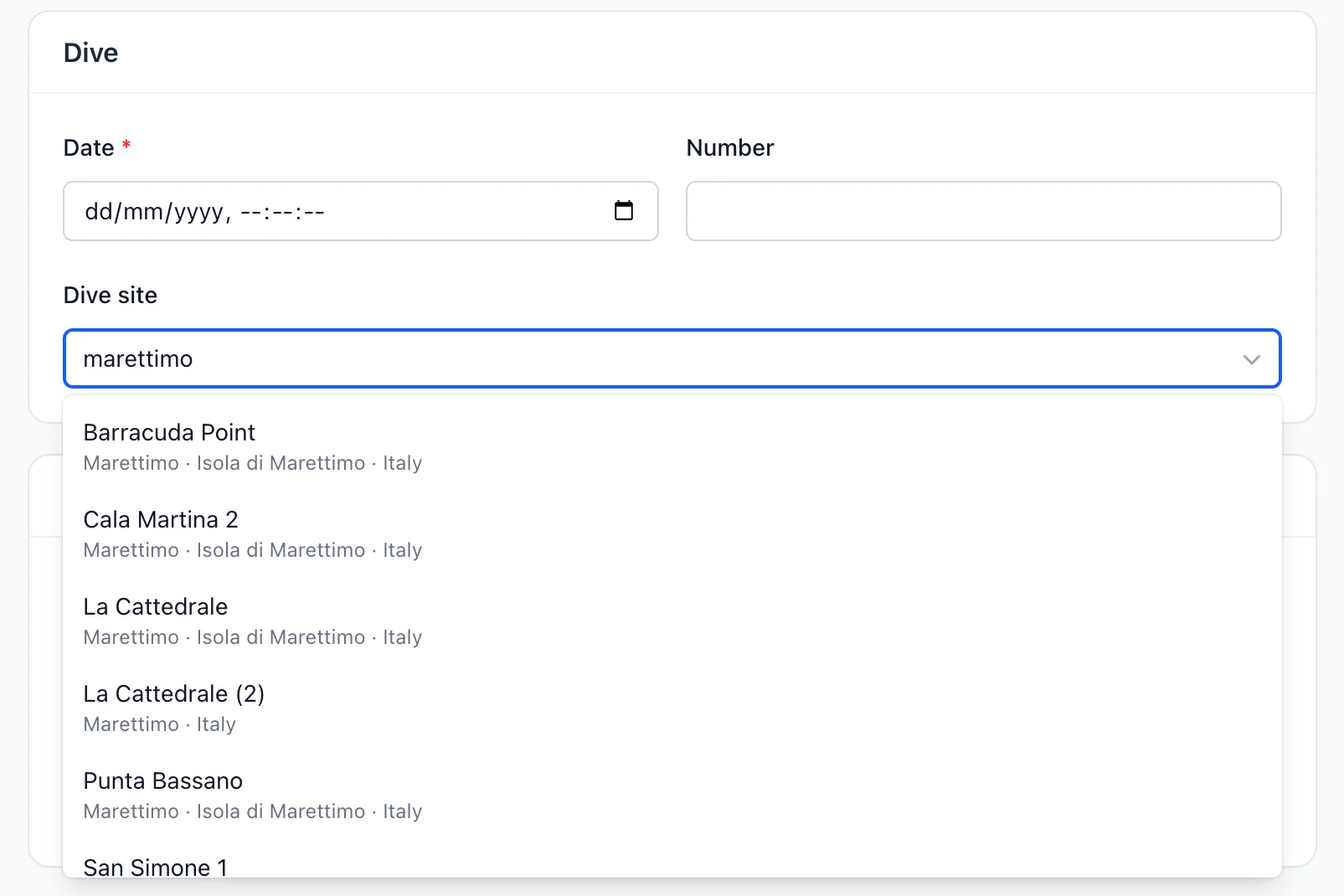
The field is now a searchable picker. Start typing and the list narrows as you go, and it matches on the place as well as the name, so marettimo finds every site on the island whether or not the island is in the site's name. Each option shows the site's place beneath it (location, region, country, whichever you've filled in), which is what tells the two House Reefs apart. Pick with the mouse or with the arrow keys and Enter, as you'd expect.
Location and Region suggest what you've already typed
Two more fields learned to help along the way, this time on the dive site form. Location and Region are free text, and free text drifts: "Marettimo" on one site, "Isola di Marettimo" on the next, "marettimo" on a third logged from a phone. Nothing is wrong with any of them, but a logbook with three spellings of the same island is harder to search, to filter and to read.
Both fields now suggest the places you've already named on your own dive sites. Click into Location, or start typing, and a list of your locations opens beneath it, narrowing as you go. Pick one and the spelling matches the site you already have. Type something new and it's accepted as it is: this is a nudge towards consistency, not a rule.
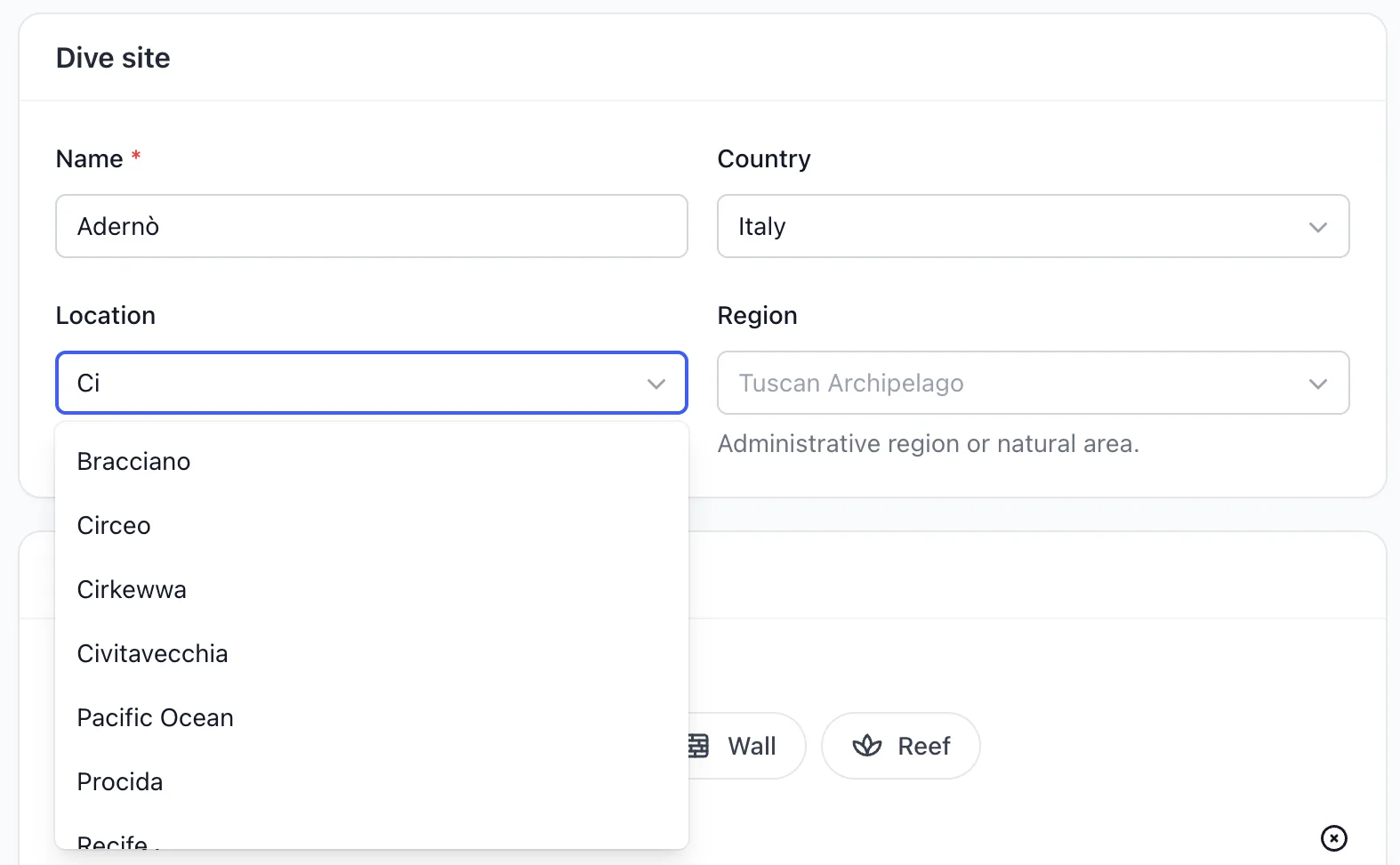
The suggestions come only from the dive sites in your own logbook, and your dive sites are private: nothing you enter is shared with other divers, and nothing another diver entered shows up in your form. A shared catalogue of places is something I'm considering, but that's a story for another day. If you've stored the same place a few different ways, the list offers the spelling you used most, once, so you can settle on it from now on.
Tags on the API
When tags arrived in July, the API was left out. Reading a dive over /v1/dives gave you every number the diver typed and none of the labels they grouped their dives by, which was an odd omission: the tags are often the most useful thing on the dive if you're building a report or a filter from outside the app.
Every dive the API returns now carries a tags array: the names of the dive's tags, in alphabetical order, or an empty array when the dive has none. It's on the list, on the single dive, and on the sync feed, so the three read alike.
{
  "id": "0198…",
  "number": 1642,
  "started_at": "2026-09-06T10:12:30",
  "tags": ["Deep", "Wreck", "type: Night"],
  …
}
The field is read-only for now. A tag is a name and nothing else, so there's no tag endpoint to address one by, and applying or removing tags through the API is a decision I'd rather make with the multi-select and the tags index it belongs with. If you decode dive responses with a strict client, note the new key.
Shared MacDive logbooks keep their dives tagged per diver
A MacDive database can hold more than one diver. Couples do it to keep both logbooks in one place, and parents do it to keep a child's dives alongside their own. Divebase was designed around a different idea: as in most dive logs, each diver has a space of their own. Today that means a separate account for each diver, though this may change in the future. The MacDive import brought the whole database into one Divebase logbook, mixing the divers together with nothing to say whose dive was whose. Two number 1s, two number 2s, and no way to tell them apart.
Now, when a database has dives from more than one diver, the import tags each dive with its diver: diver: Simone Carletti, diver: Jane Doe, and so on, one per dive. A database with a single diver imports exactly as before, since a tag every dive repeats would tell you nothing.
Because it's an ordinary tag, everything tags do applies. Click one on a dive and your logbook filters down to that person's dives, with their numbering intact. The diver: prefix is the same convention as type:: nothing parses it, and you can rename it away by tagging the dives with whatever you'd rather have. And, as with the tags themselves, if you already imported a shared database, run the import again: it only adds, and the diver tags land on the dives already there.
Splitting a database so only one diver's dives come across is still on the list. This separates the divers after the import rather than before it, which turned out to be most of what I needed.
Dive tabs resource count
Open a dive and the tab bar across the top names its sections: Overview, Profile, Conditions, Gases, Equipment, People. What it never said was what was behind each one. Did I log the gases on this dive? Was anyone with me? Each answer was a click away, and on a dive you're only skimming, four clicks to learn that three sections are empty is four too many.
The tabs that hold a list now carry a count. Gases, Equipment and People each show how many items sit in the section, in the same small pill the panel headings already use, so you read the shape of a dive from the bar before you open anything.
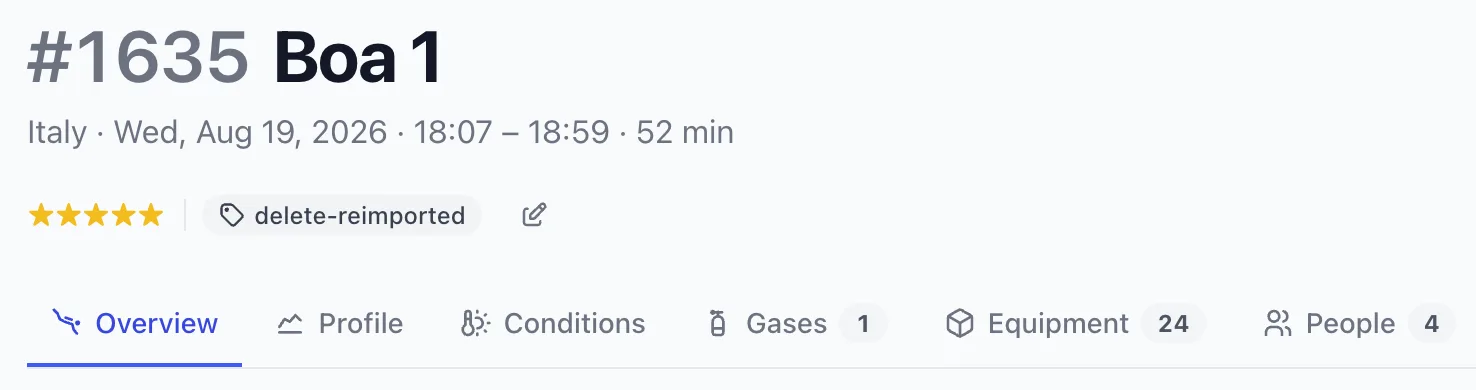
A zero is shown as a zero. A count that vanished when the section was empty would look exactly like a tab that never had one, and "nothing here" is often the answer you opened the dive for. The counts also keep up with you: add a gas or a buddy from inside the tab and the bar updates in the same breath, on a phone too, where the bar folds into a menu.
That's the lot for this round. Small things, all of them, and all of them the kind you notice on the second day and not the first. As always, dive safe! 🤿