
Introducing cylinder management
Last time I introduced gas mixes and promised the other half of the Gases section. Here it is: cylinders. A gas mix tells you what you breathe; a cylinder tells you how much of it you carry, and the two belong together.
So why bother defining your tanks at all? Two good reasons, and a third for the gear nerds.
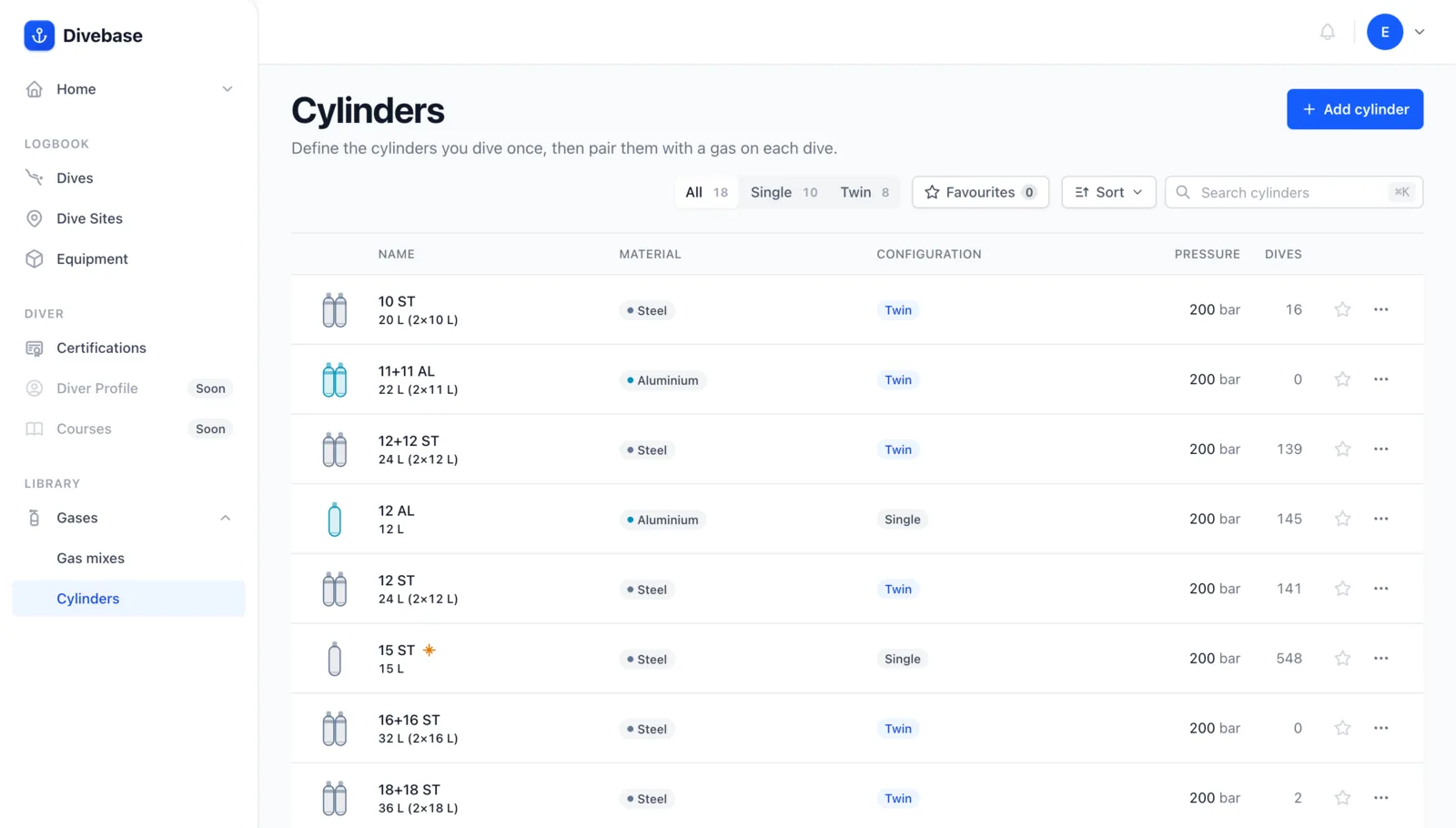
The first reason is gas consumption. Pairing the right cylinder with a dive is what lets Divebase work out how much gas you actually used, and from there your SAC (the rate at which you'd breathe it at the surface). Those numbers only make sense once the volume is known: draining 50 bar from a 15-litre tank is a very different breath from draining 50 bar out of a 12-litre one.
The second is buoyancy. A tank's material changes how it sits in the water, so steel, aluminium, and carbon each behave a little differently as they empty. If, like me, you spend most of the year diving the Mediterranean, I'd bet you've forgotten exactly how many extra kilos the Red Sea asks of you the moment that saltier water starts lifting you back up. Recording the material keeps that part of the picture honest.
Here's the form for adding one:
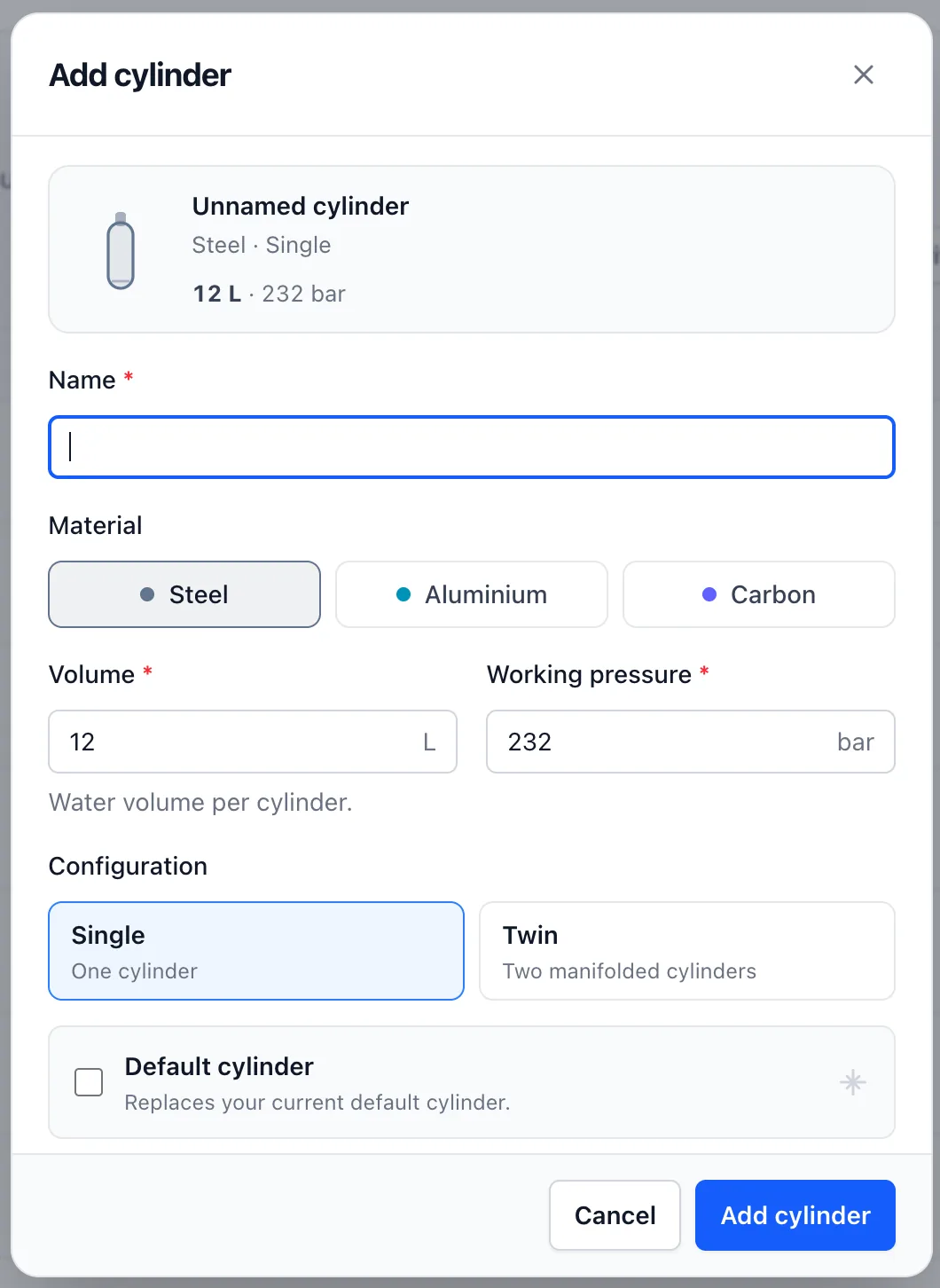
Give the cylinder a name, choose its material (steel, aluminium, or carbon), and set its volume in litres and its working pressure in bar. That's the whole tank in four fields.
Technical divers like to keep twin sets apart from singles, and Divebase obliges. Flip a cylinder to twin and it's treated as a manifolded pair: a twin 12 reads as 24 L (2×12 L), leading with the total but never losing the per-cylinder figure. A twin-12 really is a 24-litre cylinder, of course, but we're here to serve both sides of the dive deck.
You can also mark one cylinder as your default. It's the tank pre-selected whenever you log a new dive, and the one we'll reach for when importing a dive that arrives without a cylinder of its own (that's coming soon!). UDDF, for instance, has no reliable way to pin a cylinder type to a dive, even though it happily describes the gas mix; a default cylinder gives those imports something sensible to land on.
And, just as with gas mixes, you can star the cylinders you reach for most as favourites, then list, search, and filter your way back to them in a moment.
That rounds out the Gases section. Until next time, dive safe! 🤿